

Pastries & Sweets
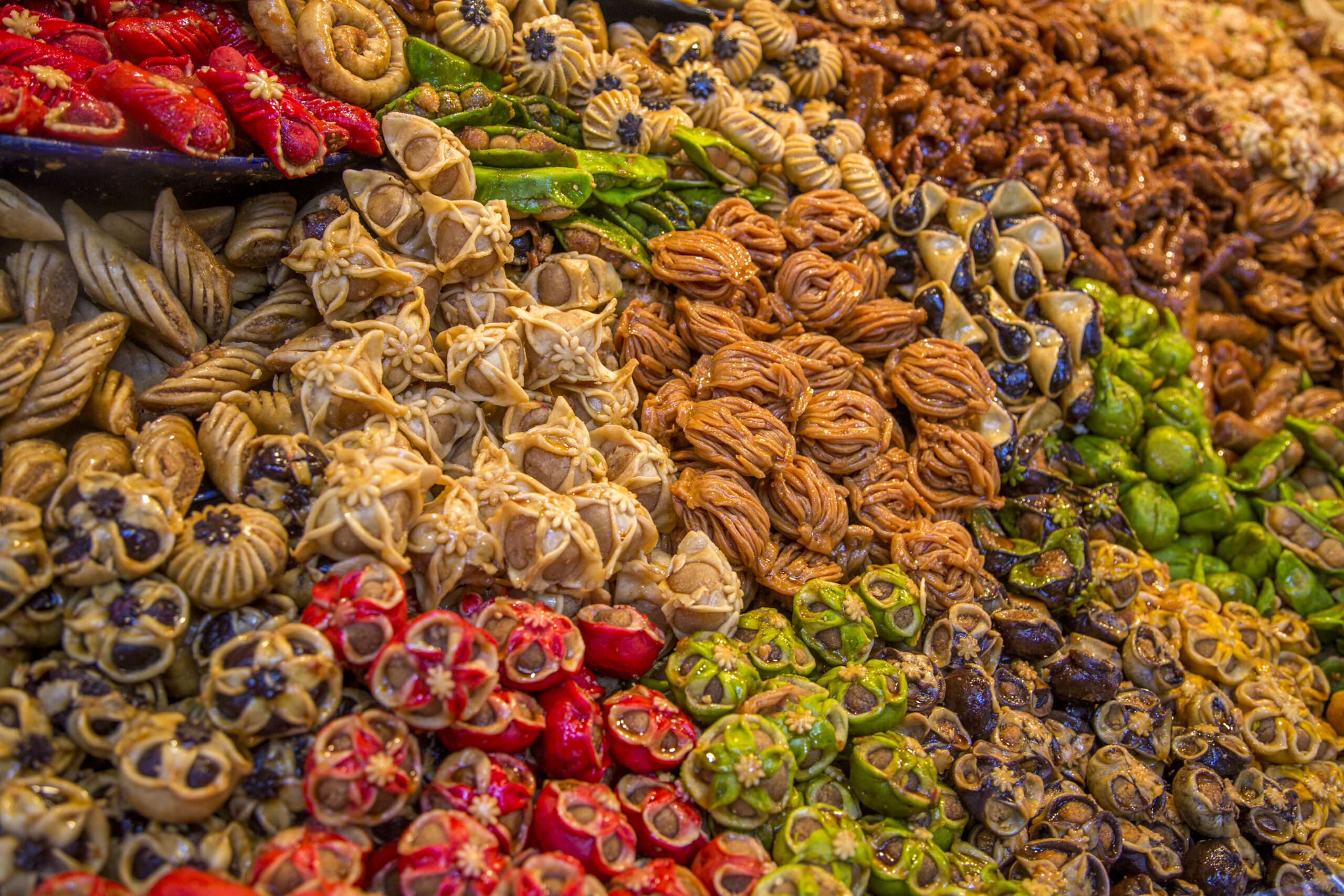
Moroccan sweets occupy a world of their own – one built on almonds, honey, orange blossom water, argan oil, and a patience in the kitchen that most modern baking cultures have largely abandoned. They are not desserts in the Western sense. They do not follow a meal as a matter of course. They appear at specific moments: with mint tea in the late afternoon, at weddings and celebrations, during Ramadan, at the table of a host who wants to honor a guest.
For travelers, Moroccan pastries are often a revelation – more complex, more fragrant, and more varied than expected. They are also easy to eat badly, in the form of mass-produced versions sold at tourist-facing shops with no connection to the craft that defines them at their best. This guide covers the pastries and sweets that genuinely matter, what distinguishes them, and where the quality tends to be highest.
The Logic Behind Moroccan Sweets
Before listing individual pastries, it helps to understand the framework that shapes them. Most Moroccan sweets are built around a small set of core ingredients – ground almonds, honey, sesame seeds, argan oil, orange blossom water, and rose water – combined in different proportions and forms to produce an enormous range of results.
The flavor profile is almost always warm, floral, and gently sweet rather than aggressively sugary. Fat comes from butter, almond paste, or argan oil. Texture ranges from crumbly to chewy to paper-crisp.
Moroccan pastry-making is also deeply seasonal and ceremonial. Certain sweets are made specifically for Ramadan, others for weddings, others for the Eid celebrations that follow the fast. Understanding this calendar dimension makes the sweets more meaningful and helps explain why the best versions are often found at home kitchens and specialist patisseries rather than year-round in tourist shops.
Cornes de Gazelle: The Benchmark of Moroccan Patisserie
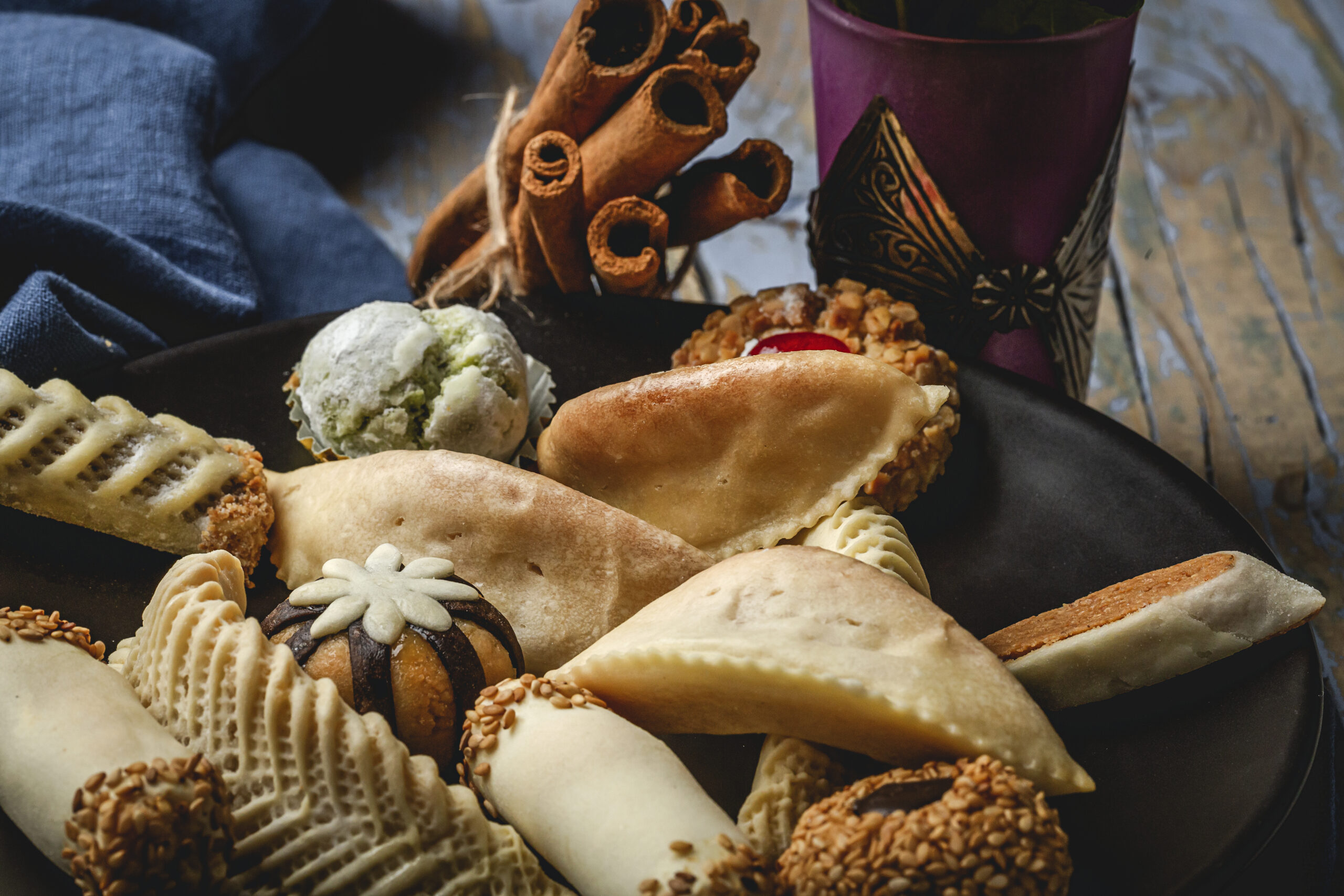
Kaab el ghazal – known in French as cornes de gazelle, or gazelle horns – is the pastry that most clearly represents the refinement at the heart of Moroccan confectionery. A thin shell of lightly sweetened pastry dough is formed into a crescent shape around a filling of almond paste flavored with orange blossom water and cinnamon, then baked until just set, with no browning. The result is pale and delicate, with a fragrance that stays in the room after the pastry is gone.
They are served with mint tea, offered to guests, and presented at every kind of celebration. The quality varies more than almost any other Moroccan sweet – a well-made corne de gazelle has a thin, barely-there crust and a filling that is moist, fragrant, and not too sweet. A poorly made one is thick-shelled, dry, and tastes primarily of sugar.
In the best Moroccan patisseries, they are made daily in small batches. At tourist shops and airport displays, they may have been sitting for days. The difference is immediately apparent on the first bite.
Chebakia: Ramadan's Most Important Pastry
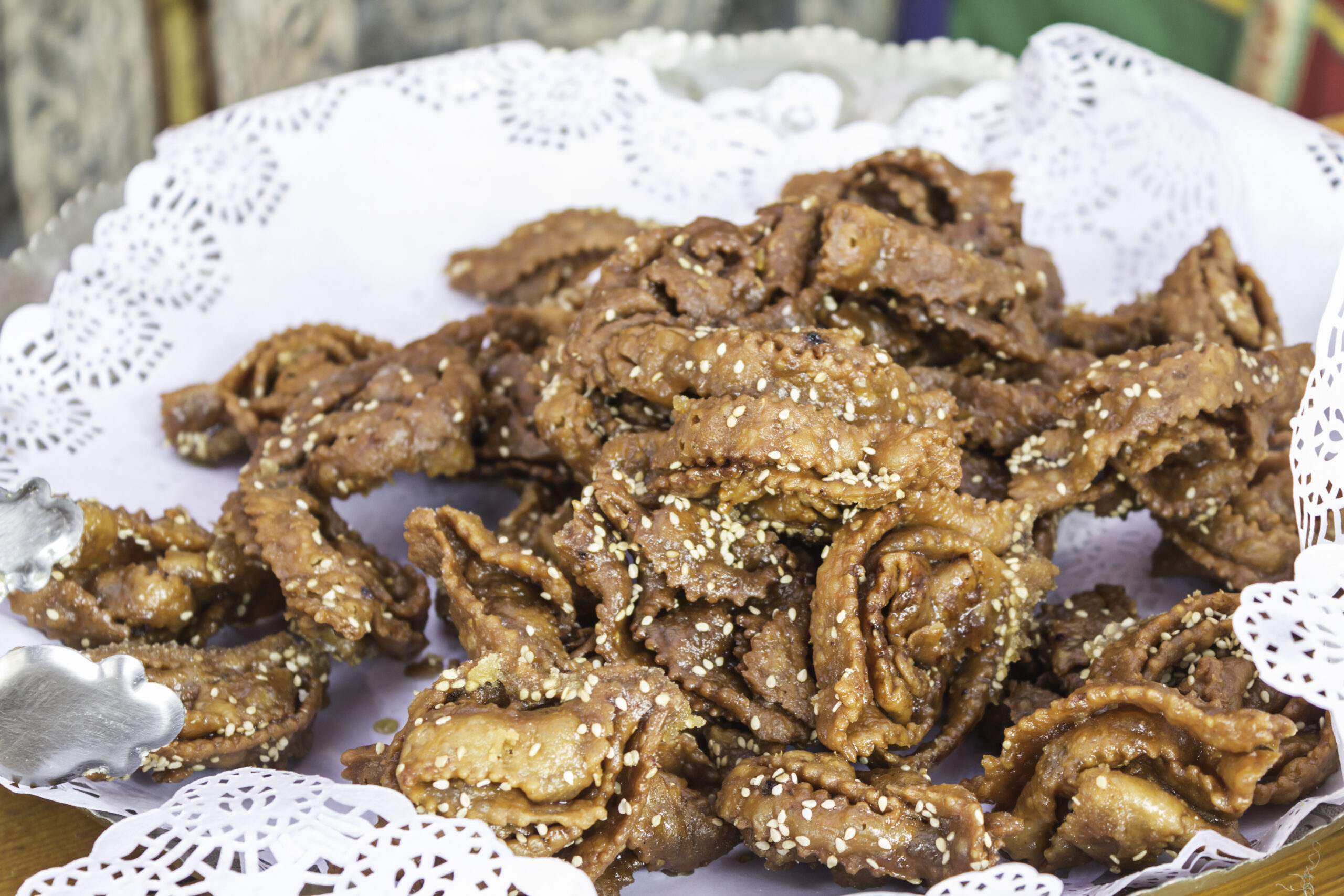
Chebakia is a sesame-rich pastry that is fried, then immediately plunged into warm honey and scented with orange blossom water before being finished with a scatter of sesame seeds. The dough is rolled, folded, and shaped – typically into a flower or figure-eight form – before frying, and the resulting pastry is simultaneously crisp, chewy, sticky, and intensely fragrant.
It is the pastry of Ramadan, eaten alongside harira each evening as the fast is broken. In Moroccan households, making chebakia is a multi-day project involving several generations of women working together – a social as much as culinary event. The quantities produced are substantial, because chebakia is also given to neighbors, taken to the mosque, and shared with anyone who visits during the month.
Outside of Ramadan, chebakia is available at specialist patisseries and at some street stalls year-round, but its natural context is the breaking of the fast, and eating it in that setting – with a bowl of harira at sunset in a Moroccan medina – is a different experience from eating it at a shop counter in July.
The flavor is distinctive: sesame and honey are the dominant notes, with a floral lift from the orange blossom water and a slight anise note from the spicing in the dough. It is not a subtle pastry, but it is a complete one.
Sellou: The Festive Paste That Defies Easy Description
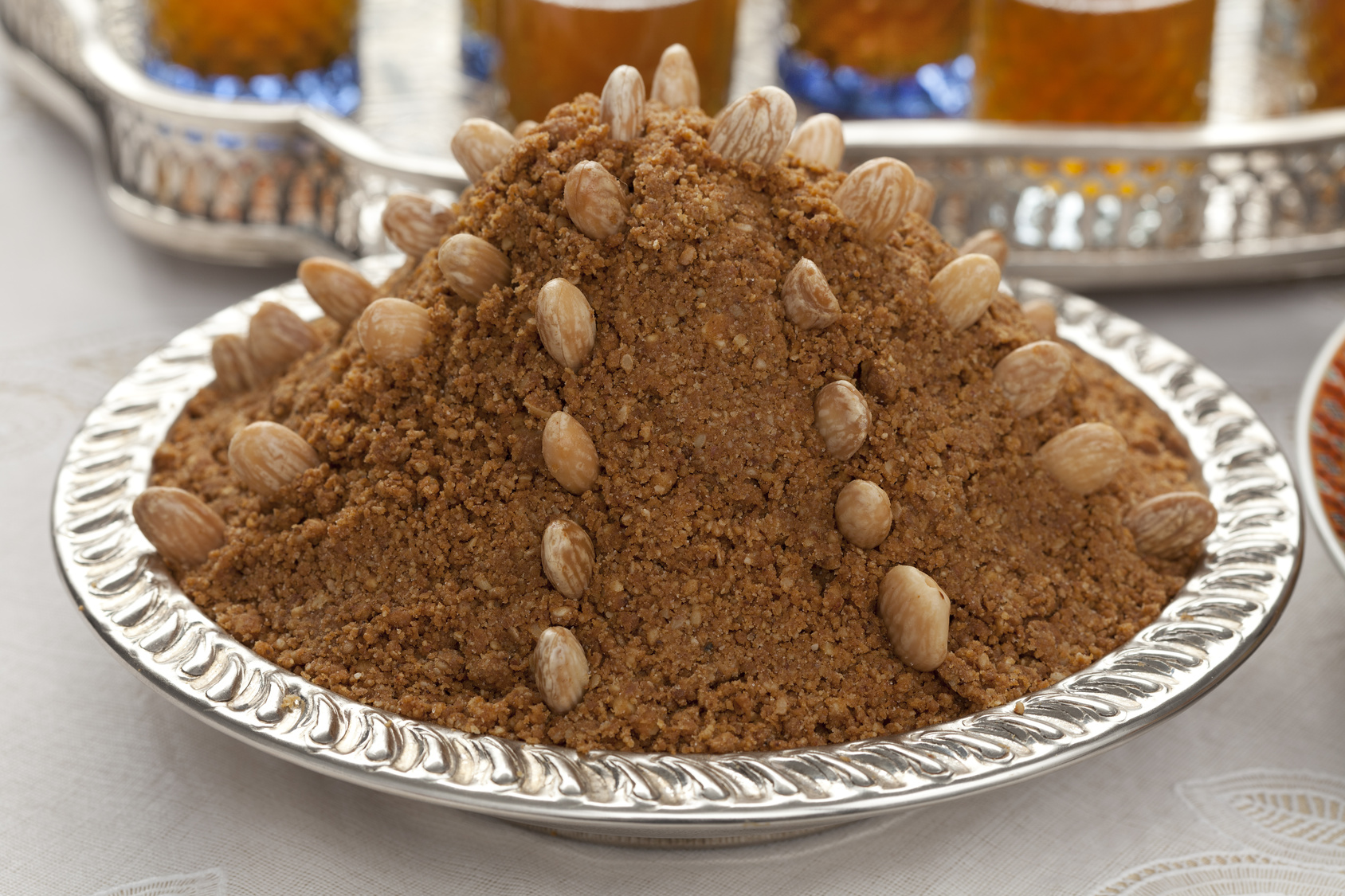
Sellou – also known as sfouf or zamita depending on the region – is not a pastry in the conventional sense. It is a dense, dry paste made from toasted flour, fried almonds, toasted sesame seeds, honey, and a blend of spices including cinnamon, anise, and fennel. The mixture is worked together until it holds its shape, then formed into a mound or rolled into balls, sometimes topped with whole almonds and a dusting of powdered sugar.
The texture is crumbly and rich, almost like a dry halva, and the flavor is deeply nutty and warmly spiced. It is a calorie-dense food with a long history as sustenance for women after childbirth and for travelers making long journeys, and that practical origin is still visible in its composition.
Sellou is made in large quantities for Ramadan and Eid, and a bowl of it tends to sit on the table throughout the festive period, available for anyone to take a small serving. It is not served at patisseries as a regular item – finding it means either being invited into a Moroccan home or seeking out a specialist who makes it seasonally.
For travelers, it is a pastry that requires a little context to appreciate. Eaten without that context, the dry, intensely flavored paste can seem puzzling. Understood as a celebration food with centuries of domestic history behind it, it makes complete sense.
Briouats: Pastry That Crosses the Sweet-Savory Line
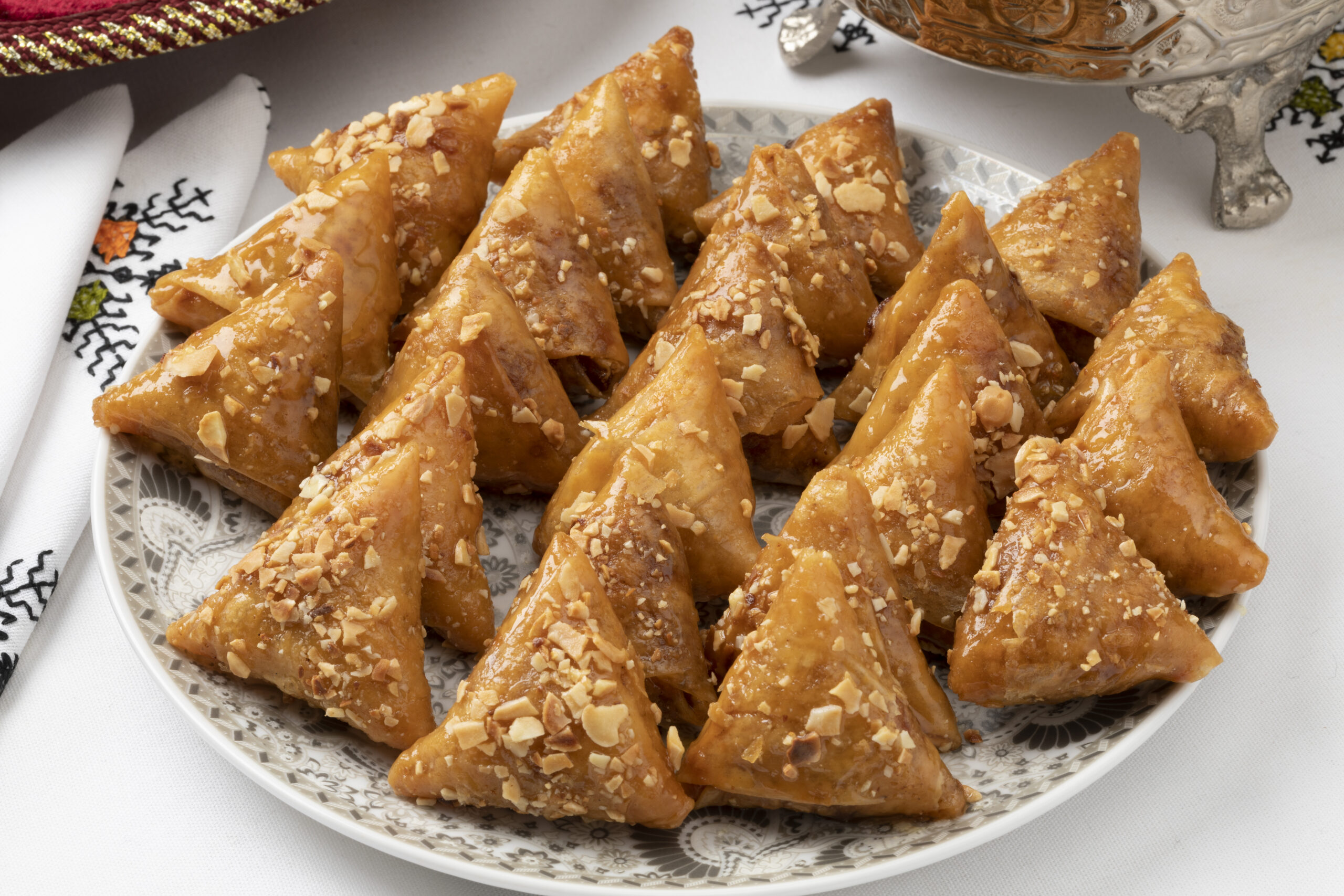
Briouats exist on both sides of the line between savory and sweet, which is one of the qualities that makes them interesting. The pastry is warqa – the same paper-thin dough used for pastilla – folded around a filling and then either baked or fried until the exterior is shatteringly crisp.
In their sweet form, briouats are filled with almond paste scented with orange blossom water and cinnamon, sometimes with a thread of honey incorporated into the filling, and finished with a drizzle of honey over the surface after frying. The contrast between the crisp, neutral pastry and the fragrant, rich almond interior is one of the more elegant combinations in Moroccan baking.
Savory briouats – filled with kefta, cheese, or chicken – belong to the appetizer and street food world rather than the pastry context, but the same pastry and the same folding technique connects them. Understanding briouats as a format rather than a single dish explains much of the range of Moroccan pastry cooking.
Sweet briouats are widely available at Moroccan patisseries and are among the more accessible Moroccan pastries for visitors, both in terms of finding them and in terms of the flavor profile, which does not require much contextual knowledge to enjoy immediately.
Fekkas: The Moroccan Biscotti
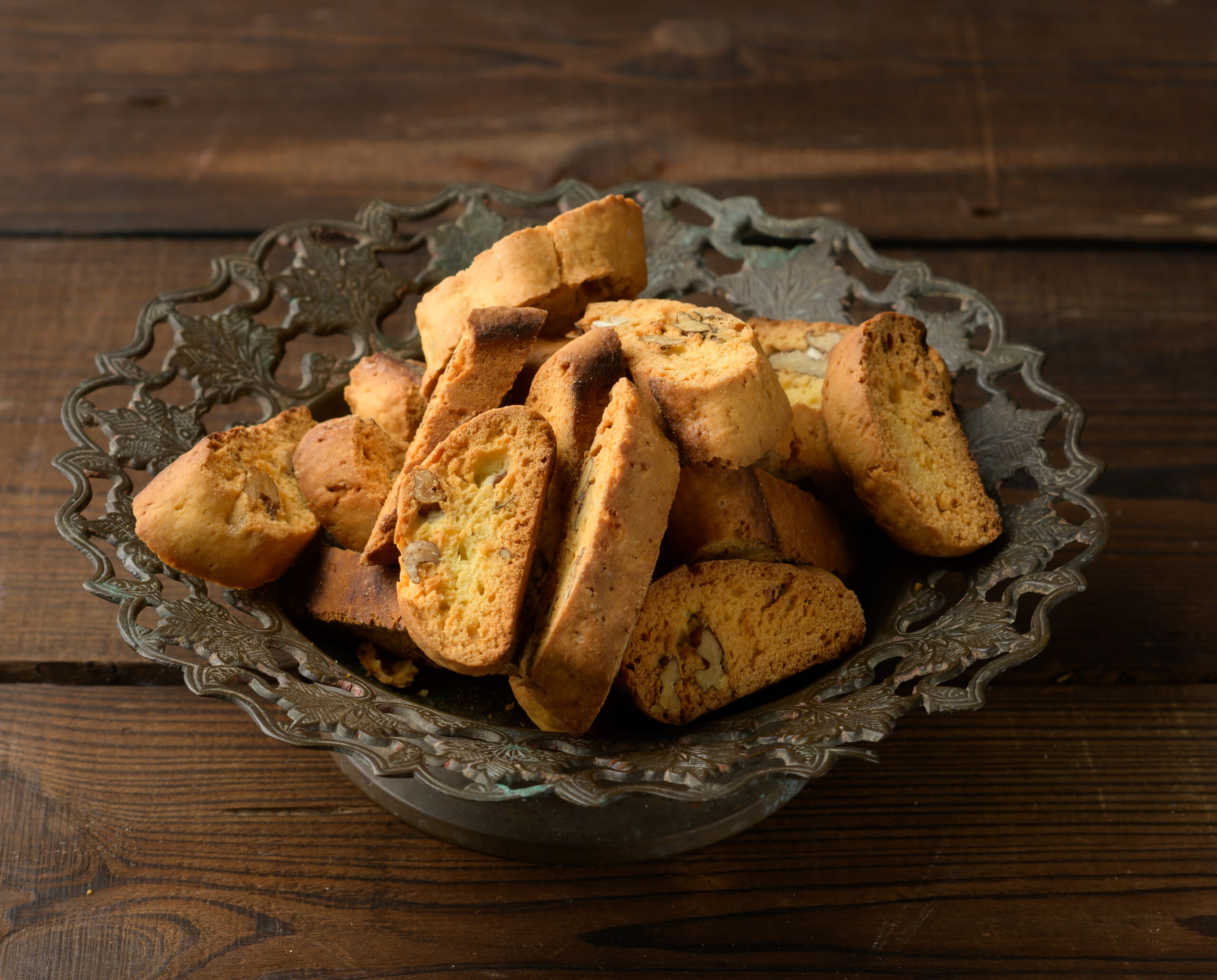
Fekkas are twice-baked, dry, crunchy biscuits that function as Morocco’s answer to Italian biscotti – not by influence or borrowing, but by parallel logic. A dough enriched with eggs, butter, and sugar is baked once as a log, then sliced and returned to the oven to dry out completely, producing a biscuit that is hard, very shelf-stable, and designed to be dipped in tea.
The flavor varies considerably by recipe. The most classic versions include whole almonds, raisins, sesame seeds, and anise – a combination that is subtly sweet, slightly savory from the sesame, and faintly herbal from the anise. Other versions include orange zest, chocolate, or dried fruit. Some regional preparations use argan oil in place of butter.
Fekkas are everyday biscuits rather than celebration pastries – the kind of thing that sits in a tin in a Moroccan kitchen for weeks, available whenever tea is made. In patisseries and at the better medina sweet shops, they are sold loose by weight, which is the most reliable way to find a good version.
Plan your Morocco Trip with our Free Morocco Travel Maps
Ready-made itineraries for 3, 7, 10 and 14 days
Best spots by city, coast, desert & mountains
Handpicked hotels, riads & resorts
Restaurants, viewpoints & activities
Key neighborhoods & transport tips
Free access. Regular updates. No spam.
Ghoriba: The Crumbly Cookie With Many Faces
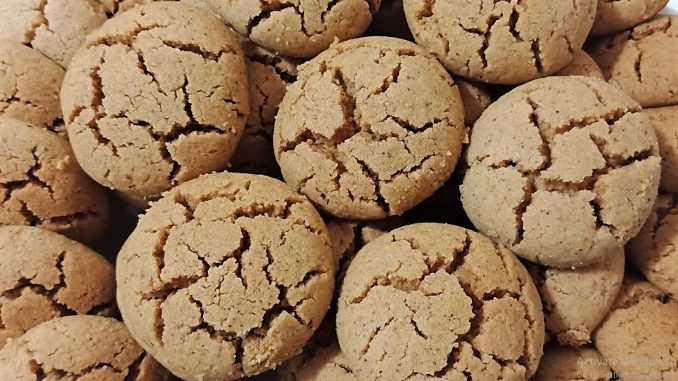
Ghoriba is a broad category of Moroccan shortbread-style cookies rather than a single recipe, and the range within it is considerable. All ghoriba share a characteristic texture – crumbly, slightly sandy, and tender – but the flavoring changes by region, household, and occasion.
The most widespread version is made with sesame seeds and honey, producing a cookie that is dense, slightly chewy at the center, and covered in a fine crack pattern on its surface from the oven. Almond versions, sometimes flavored with orange blossom water or lemon zest, are equally common. In some regions, coconut ghoriba are popular. In others, the cookies are made with chickpea flour, producing a slightly earthier, more mineral flavor.
Ghoriba are not showy pastries. They sit on patisserie shelves in unassuming mounds, and they do not announce themselves. But a good ghoriba – particularly the sesame-honey version eaten still slightly warm, with a glass of mint tea – is one of those small, cumulative pleasures that stays in the memory of a trip long after the more dramatic experiences have faded.
Baghrir: A Thousand Holes, One Perfect Texture
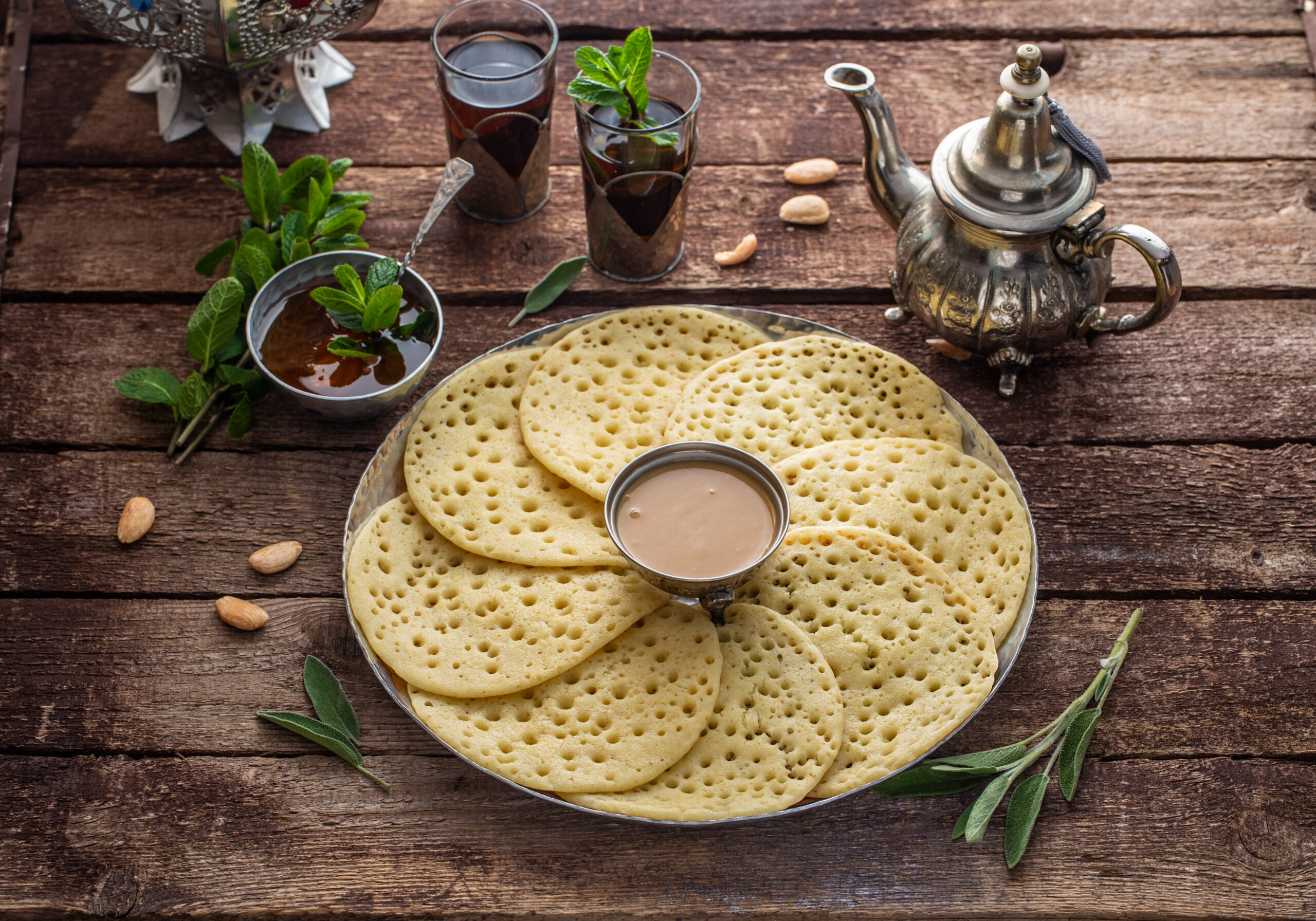
Baghrir – known as the thousand-hole pancake – is made from a thin, yeasted semolina batter cooked on one side only, on a dry griddle. As it sets, the entire surface opens into a honeycomb of tiny bubbles that give the pancake its distinctive appearance and, more importantly, its function: that porous surface is designed to absorb. The traditional finish is warm melted butter and honey, which seeps into the holes immediately and saturates the pancake from edge to edge.
It is breakfast and afternoon tea food – served at home and at traditional cafes, never really at street stalls. It requires sitting down, and it does not travel well. A well-made baghrir has an even bubble structure, a texture that holds without dissolving, and enough depth to carry the richness of the butter without becoming heavy. At a good riad breakfast or a traditional cafe, it is one of the most quietly excellent things on the Moroccan morning table.
Sfenj: The Doughnut That Belongs to the Morning
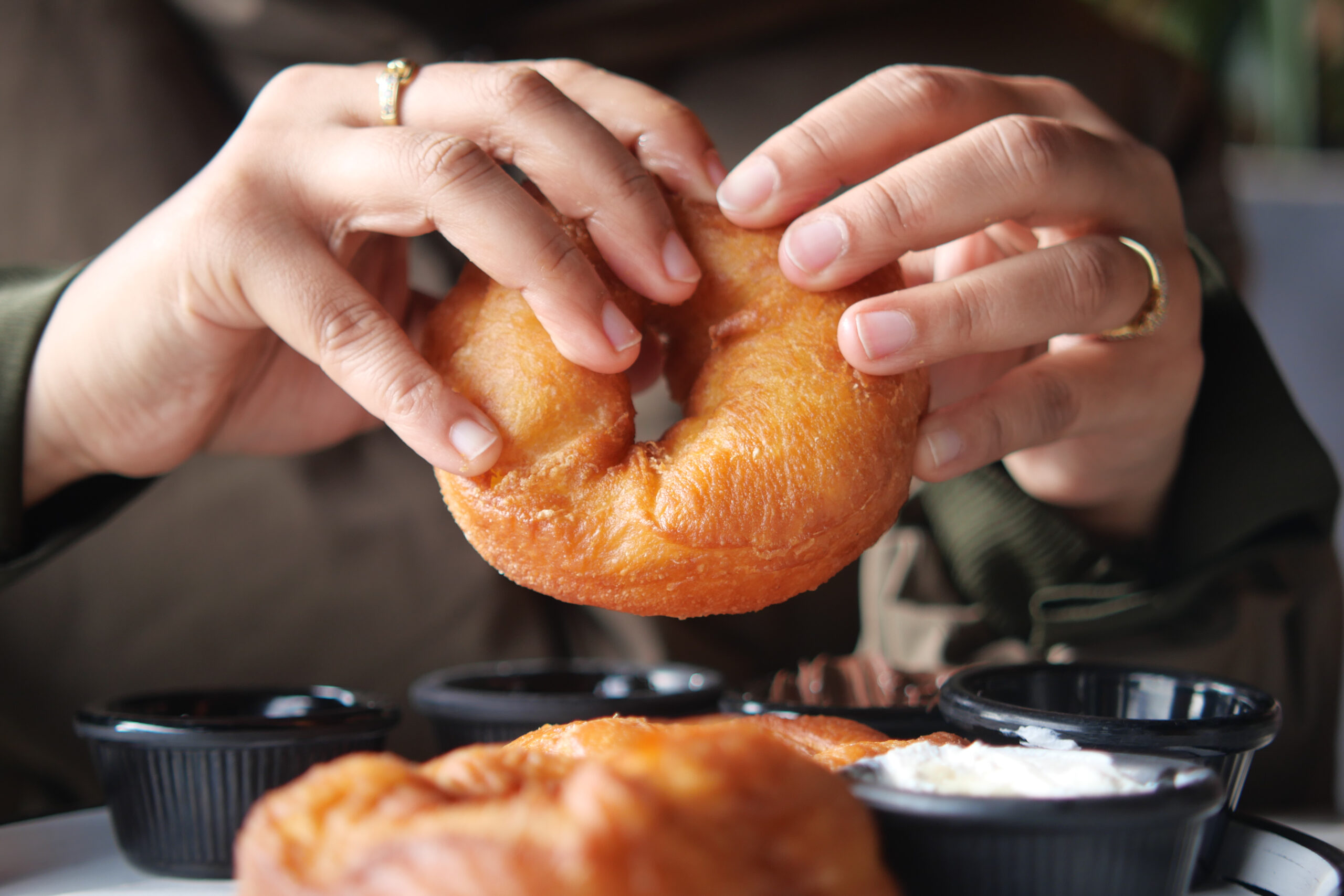
Sfenj are ring-shaped doughnuts made from a loose, yeasted dough – wetter than most European equivalents – pulled into rough rings and dropped into very hot oil. They emerge puffy, irregular, and golden, with a blistered crust and a soft, slightly chewy interior. No two are exactly the same shape, and that informality is part of their character.
They are sold in the early morning from street stalls, pulled from the fryer with long hooks and threaded onto reed grass or wire, sold in small bunches wrapped in paper. Eaten plain, dusted with sugar, or dipped in honey, they are morning food in the most specific sense – best consumed within minutes of leaving the oil. A fresh sfenj is light, fragrant, and genuinely pleasurable. A cold one makes a poor case for itself. If the stall is quiet when you arrive, wait for the next batch.
Mint Tea and the Context That Cannot Be Separated
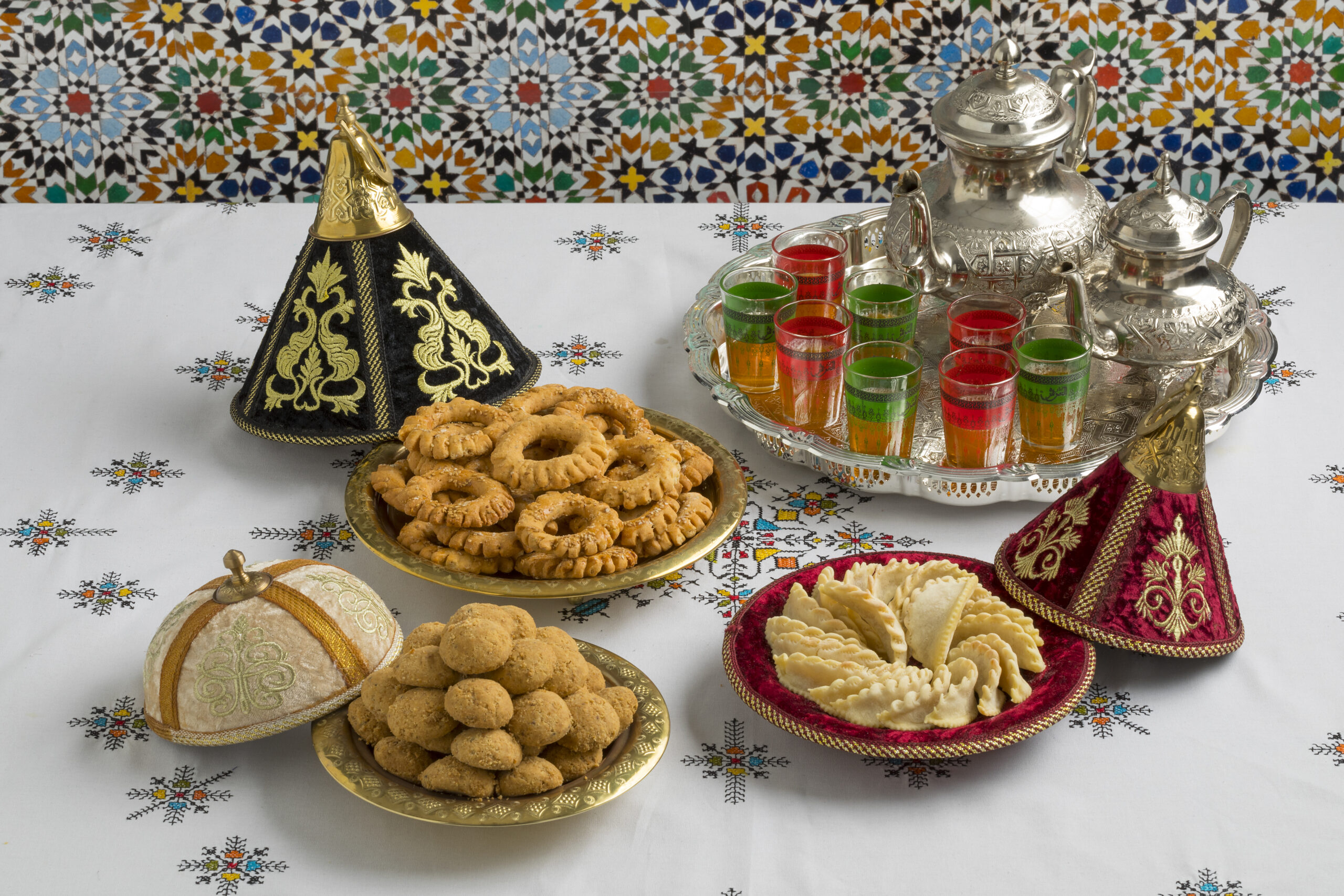
No guide to Moroccan sweets is complete without acknowledging that Moroccan pastries and Moroccan mint tea are not separate experiences. They are designed for each other. The sweetness of the tea – poured from a height to create a foam, heavily sugared, fragrant with fresh mint – is calibrated to balance the richness of the pastries. Eating a corne de gazelle without tea is like drinking wine without food: not wrong, exactly, but missing the point.
The ritual of Moroccan tea service – the glasses arranged on a tray, the theatrical pour, the three glasses that tradition recommends (the first described as gentle as life, the second strong as love, the third bitter as death, though the sugar levels in Morocco tend to complicate this metaphor) – is as much a part of the pastry experience as the pastry itself.
Visitors who slow down enough to sit with tea and a plate of sweets, rather than buying a pastry to eat walking, get a fundamentally different and more complete understanding of what Moroccan confectionery is actually about.
Where to Find the Best Moroccan Pastries
- Fez has a long claim to being the city of Moroccan refinement, and its patisserie culture supports that claim. The medina of Fez el-Bali contains specialist sweet shops and patisseries that have been operating for generations, making pastries for weddings and celebrations using recipes that have changed little. Cornes de gazelle and briouats from the best Fez establishments set a standard that is difficult to match elsewhere.
- Casablanca offers the widest range of modern Moroccan patisseries – some operating at a genuinely high level, with contemporary presentation alongside traditional recipes. The city’s size and its more cosmopolitan character mean that pastry culture here has been shaped by both French influence and domestic tradition, producing establishments that feel familiar in format but distinctly Moroccan in flavor.
- Rabat has a refined patisserie culture that is less frequently discussed than Fez or Casablanca but merits attention. Several establishments in the capital produce excellent petit four selections and maintain strong standards for the classic pastries.
- Marrakech offers tourist-facing pastry shops in abundance, and some genuinely excellent ones – but requires more discernment to navigate than the other cities. The medina’s tourist lanes contain many shops selling mediocre, overpriced pastries to visitors who do not know the difference. Moving into residential neighborhoods and seeking out local patisseries with a Moroccan clientele produces consistently better results.
- Taroudant and the Souss Valley are worth mentioning specifically for amlou – the almond-argan paste that is produced in this region and is at its best here, bought directly from cooperatives or producers rather than in tourist shops elsewhere.
How to Buy Moroccan Pastries Well
- Buy from shops with local customers. This is the most reliable signal in any Moroccan city. A patisserie where Moroccan women are buying sweets for a family occasion is almost always better than one positioned primarily for tourists.
- Buy by weight, in small quantities first. Most Moroccan patisseries sell loose pastries by the piece or by the kilo. Buying a small selection before committing to a larger purchase allows you to assess freshness and quality without overinvesting.
- Ask when things were made. Chebakia soaked in honey keeps reasonably well. Cornes de gazelle do not – they dry out within a day or two, and a dried-out corne de gazelle is an entirely different and much less interesting pastry. Freshness matters more for some items than others, and asking is entirely acceptable.
- Avoid vacuum-sealed tourist packaging. Moroccan pastries in cellophane gift boxes designed for the airport or the souvenir shop are almost universally inferior to the same pastries bought fresh from a working patisserie. If you want to bring something home, buy from a good patisserie and pack carefully – they travel better than you might expect for two or three days.
- Engage with the occasion. If you are in Morocco during Ramadan, Eid, or a wedding season, the pastry culture is operating at a different level of intensity and investment than at other times of year. This is the best time to encounter chebakia, sellou, and briouats made with real care and in genuine quantity.
Page last updated: June 2026
Anything we can improve? Let us know
Plan Your Morocco Trip
Compare hotels, flights and rental cars
Compare hotels, riads and guesthouses across Morocco on Booking.com:
Compare flights to Morocco on Aviasales:
Find the right rental car for your Morocco trip with EconomyBookings: