

Casablanca
Morocco’s largest city on the Atlantic coast
Recommended
#3 Most visited in Morocco
Casablanca (“ⴰⵏⴼⴰ” in Amazigh & “الدار البيضاء” in Arabic) is Morocco’s largest city, its economic engine, and its most modern metropolis. It is not the Morocco of fairy-tale medinas or rose-tinted riads – and that is precisely the point. What you get here is a real, working, ambitious Atlantic city with serious architecture, excellent food, and a pace of life that feels genuinely urban.
If you are chasing ancient souks, snake charmers, and old-world atmosphere, Marrakech or Fes will serve you better. But if you want to understand contemporary Morocco – how it lives, eats, builds, and moves – Casablanca is the place to do it.
Casablanca at a glance
- Best for: Hassan II Mosque, Art Deco, food, modern Morocco, business travel
- Ideal stay: 1 to 2 days
- Best season: spring or autumn
- Skip if: you want a classic medina, riads, and postcard Morocco
- Best area to stay: Gauthier, Maarif, Anfa or Aïn Diab for the Corniche
Why visit Casablanca?
Casablanca rewards a specific type of traveler: someone who genuinely enjoys cities, architecture, food culture, and the texture of everyday modern life in a country they are exploring.
The Hassan II Mosque alone is one of the most extraordinary buildings in the Islamic world, and it is reason enough to come. Beyond that, the city offers a remarkable stock of Art Deco architecture in its downtown core, a lively oceanfront along the Corniche, a French colonial quarter worth walking, and a restaurant and café scene that is easily the best in Morocco.
Casablanca is not a destination that reveals itself quickly or dramatically. It takes a little curiosity. But for travelers who bring that, it delivers something most Moroccan cities cannot: a window into how Morocco actually works today.
How many days in Casablanca?
1 day: Enough to see the Hassan II Mosque, walk through the Art Deco center and Habous Quarter, and have a good meal. This is the minimum, and it works well if Casablanca is a stopover within a larger Moroccan itinerary.
2 days: The better option. A second day lets you explore more deliberately – the Corniche at leisure, the old medina, Place Mohammed V, and more time in the neighborhoods that give the city its character. You will leave with a more complete picture.
3 days or more: Only makes sense if you have a specific reason to stay – business, a day trip to Rabat or El Jadida, or a genuine interest in urban Morocco. For most leisure travelers, two days is the sweet spot.
Best time to visit Casablanca
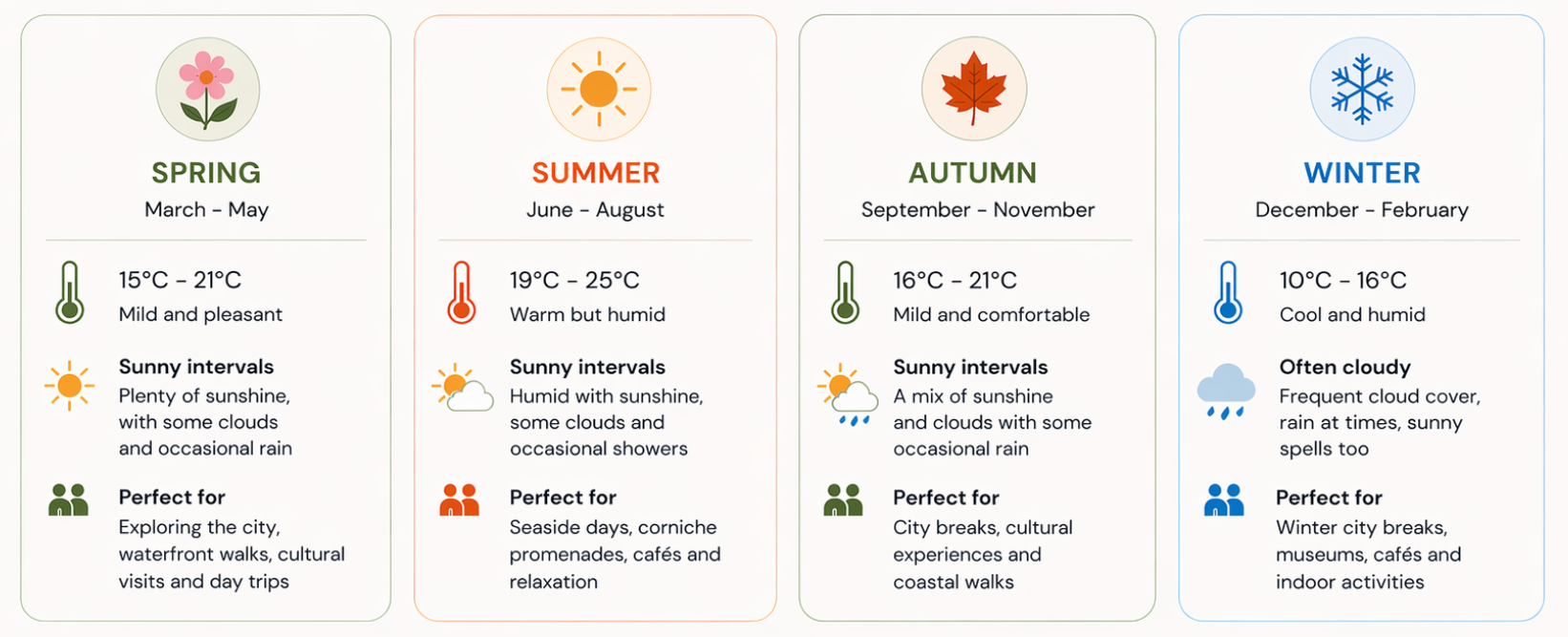
Spring and autumn are the best seasons to visit Casablanca. The weather is usually mild, pleasant, and more balanced than in many other Moroccan cities, with comfortable temperatures, regular sunshine, and a fresh Atlantic breeze. These seasons are ideal for exploring the city, walking along the Corniche, and enjoying Casablanca without the heavier humidity of summer or the cooler, cloudier feel of winter.
Summer remains enjoyable, especially by the coast, but it can feel humid. Winter is generally mild, though often grayer and less predictable.
First time in Casablanca
It is a big city, and it behaves like one. Casablanca is spread out, traffic is real, and distances add up quickly. This is not the kind of place where you casually drift between all the main sights on foot.
It does not match the postcard version of Morocco. Many first-timers arrive expecting old medina romance and leave saying the city felt too modern. That is not because Casablanca fails. It is because people arrive with the wrong brief.
Tourism is not the city’s main purpose. That is part of the appeal. Casablanca can feel more real, less staged, and more useful than the country’s more obvious tourist cities.
The old medina is worth seeing, but expectations should be calibrated. Forum trip reports describe it as interesting, crowded at times, and easy to get disoriented in, especially if you rely too much on your phone. That does not make it unsafe by default, but it does make it a place where you should stay alert and keep moving with purpose.
The Hassan II Mosque takes some planning. Non-Muslim visitors cannot just wander in freely. You join an official guided visit, and the forums repeatedly note that many third-party “skip the line” products add little unless you are in a very specific high-pressure cruise context.
Casablanca is easy enough to do independently if you keep the route simple. That comes through strongly in the forum threads, especially from cruise visitors who found the city more manageable than expected once they ditched expensive private tours.
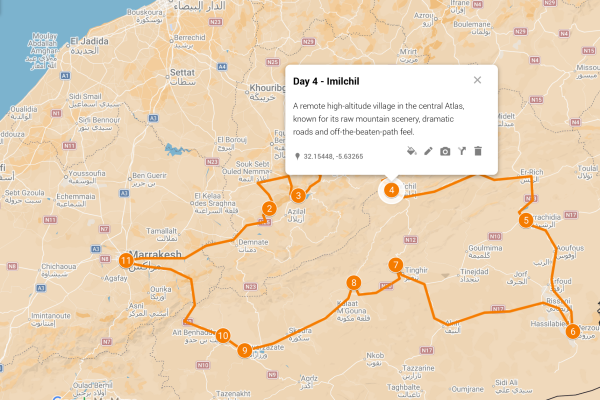
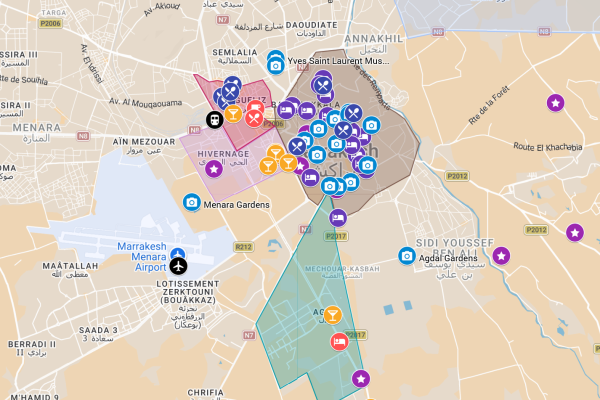
Plan your Morocco Trip with our Free Morocco Travel Maps
Ready-made itineraries for 3, 7, 10 and 14 days
Best spots by city, coast, desert & mountains
Handpicked hotels, riads & resorts
Restaurants, viewpoints & activities
Key neighborhoods & transport tips
Free access. Regular updates. No spam.
Top attractions in Casablanca
Hassan II Mosque: There is no contest for the top sight in Casablanca. The Hassan II Mosque is one of the largest mosques in the world, built on a promontory over the Atlantic, with a minaret that reaches 210 meters into the sky. The craftsmanship inside – carved cedarwood, hand-laid zellige tilework, Italian marble – is exceptional. Guided tours for non-Muslim visitors run several times daily and are absolutely worth taking. This is a genuine highlight of any Morocco trip, not just of Casablanca.
Downtown Casablanca and the Art Deco center: The area around Boulevard Mohammed V and the central market district contains some of the finest Art Deco and Mauresque architecture in North Africa. Built largely during the French Protectorate era (1912-1956), these buildings blend European modernism with Moroccan decorative detail in ways that are often surprising and elegant. A self-guided walking tour of this area takes about 90 minutes and costs nothing.
Marché Central: One of the most useful stops in Casablanca if you want something grounded, local, and food-oriented rather than purely monumental. Forum advice repeatedly points travelers here for seafood, lunch, and a more everyday side of central Casablanca. It also fits naturally into a self-guided walk through the Art Deco core.
Place Mohammed V: The civic heart of the city, surrounded by the Palace of Justice, the Wilaya (Prefecture), the post office, and the Bank of Morocco. The fountain at its center and the formal layout of the square give a sense of the ambition that shaped colonial-era Casablanca. Good for an orientation walk.
Habous Quarter: Built in the 1930s as a planned residential quarter for the local population, Habous is a fascinating hybrid: a new medina designed by French urban planners with traditional Moroccan architecture. The result is more orderly and less overwhelming than a traditional medina, with covered arcades, pastry shops, bookstores, and a small but worthwhile craft market. It is one of the more pleasant areas in the city to walk.
The Corniche and Ain Diab: the oceanfront strip stretching west from the Hassan II Mosque is where Casablancans come to eat, socialize, and breathe sea air. It is not a beach destination in the Mediterranean sense – the Atlantic here is moody and the coastline is developed – but the Corniche has energy, especially on evenings and weekends. Good restaurants, cafés, and a walk with the ocean always in view.
Old Medina: Casablanca’s old medina is small by Moroccan standards and considerably less atmospheric than those in Fes or Marrakech. That said, it is real and unhurried, with fewer tourists and more genuine day-to-day commerce. Worth an hour or two if you want to experience an older Casablanca, but set expectations accordingly.
Arab League Park (Parc de la Ligue Arabe): A large formal garden in the center of the city, good for a morning walk. The surrounding streets contain some of the best preserved Art Deco buildings in the area, making the park a useful starting point for an architectural exploration.
Morocco Mall: Not a traditional sight, but a useful reference point for understanding modern Moroccan consumer culture. One of the largest malls in Africa, with an aquarium inside and direct access to the Ain Diab shoreline. Worth a visit if you are interested in how urban Moroccan middle-class life looks today.
Where to stay - quick overview
City center / downtown: The most practical base for first-time visitors who want to see central Casablanca, move around easily, and stay close to major transport links. Good for short stays and architecture-focused visits, but not the city’s most pleasant or polished area.
Gauthier / Racine: One of the best all-round areas to stay in Casablanca. More relaxed, more walkable, and more consistently enjoyable than the city center, with good cafés, restaurants, and a better day-to-day feel. A strong choice for independent travelers who want a comfortable urban base without going fully business-hotel or fully oceanfront.
Maarif / Palmier: A lively, practical district with shopping, restaurants, and a more everyday Casablanca feel. Better for convenience and city life than for charm. This is a solid base for travelers who want good value, easy access to services, and a more local urban atmosphere.
Anfa: A more upscale and residential part of Casablanca, with a more polished feel than Maarif or downtown. Best suited to travelers looking for higher-end stays, quieter surroundings, and a more premium side of the city, though it is less useful if your priority is walking everywhere.
Ain Diab / Corniche: The best option for travelers who want the Atlantic nearby, a more leisure-oriented setting, and easier access to oceanfront restaurants and upscale hotels. Better for seafront atmosphere than for exploring central Casablanca, which usually requires a taxi or tram ride.
Near Casa Voyageurs or Casa Port: Useful for very short stays or onward train travel. Practical, but rarely the most enjoyable area for a proper city stay.
For more details, check our detailed Casablanca Hotel Guide.
Hotels in Casablanca
Best tours from Casablanca
2
Tangier Day Trip by High-Speed Train
Reach Tangier fast by high-speed train for an unforgettable Day Trip.
Day-trip
5
Desert Tour to Marrakech Via Chefchaouen
Cross Morocco via Chefchaouen, Fes and the Sahara.
6 Days
6
Private Grand Tour of Morocco
Explore Morocco’s cities, desert and mountain landscapes.
11 Days
Getting there and around
Getting to Casablanca
Casablanca airport: Mohammed V International Airport is the main international gateway to Morocco and handles the majority of long-haul and European flights into the country. It is a large, functional airport located about 30 kilometers southeast of the city center. For most visitors flying into Morocco, Casablanca is the entry point.
Cash, ATMs, and airport basics: This matters more than many guides admit. It is smart to get dirhams from an ATM at the airport rather than arrive relying on exchanged cash or foreign currency. Cash still matters in Casablanca.
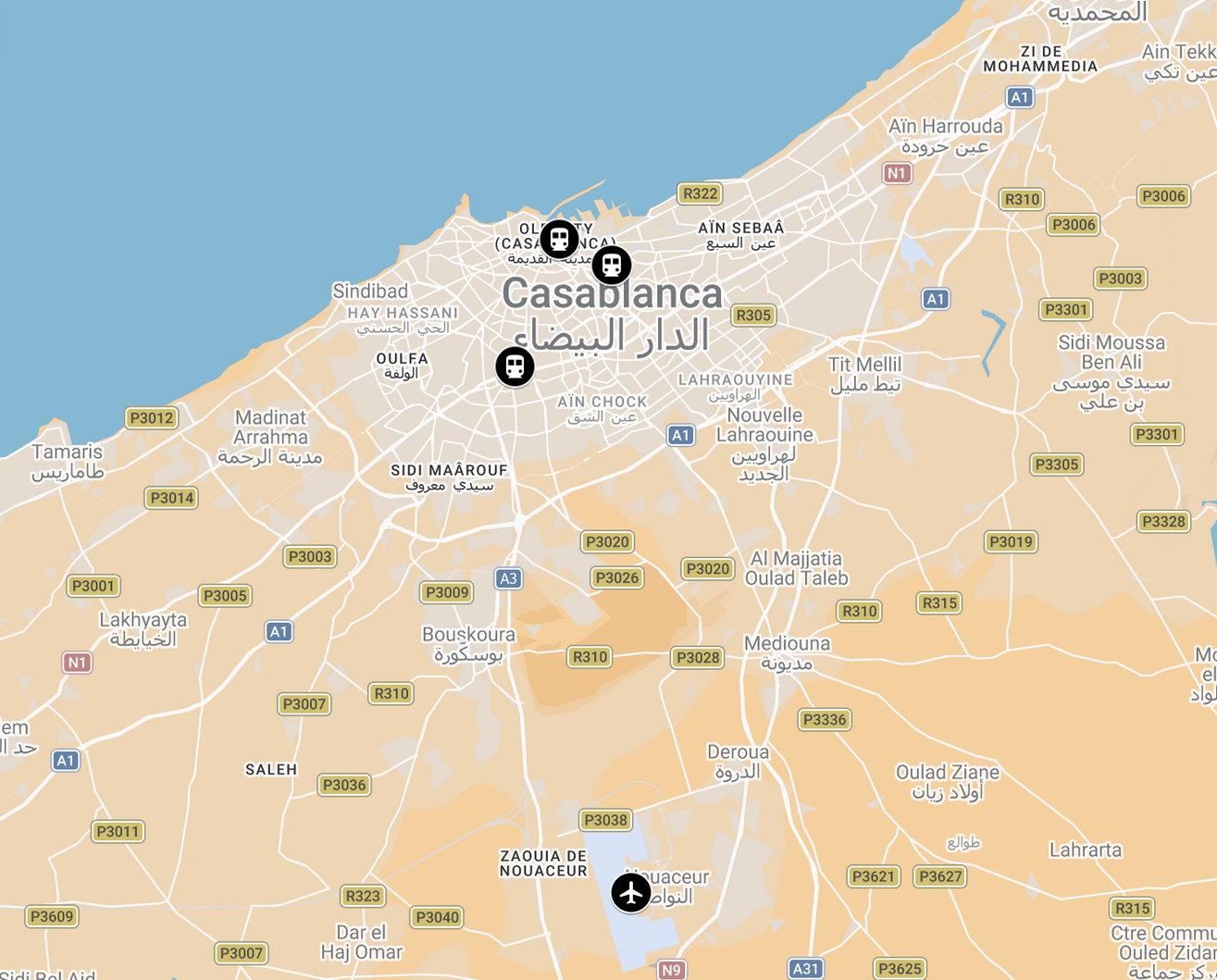
Airport to city: The best option is the ONCF train (Al Massira line), which runs directly from the airport to Casa-Voyageurs and Casa-Port stations in the city. Trains run approximately every 30 minutes, the journey takes around 45 minutes, and the price is very reasonable. This is by far the most reliable and stress-free option.Taxis from the airport exist but require agreeing on a price in advance or using a metered grand taxi. Be clear on the price before you get in.
Trains within Morocco: Casablanca is the hub of the Moroccan rail network. Direct trains connect to Rabat (1 hour), Fes (around 4 hours), Tangier (around 5 hours), and Marrakech (around 3 hours). The ONCF train system is comfortable, affordable, and the best way to move between Moroccan cities. Casablanca has multiple stations; Casa-Voyageurs is the main long-distance station.
Getting around
Taxis: Petit taxis (small metered city taxis) are the most practical way to move around Casablanca. They are plentiful, affordable, and generally use meters. Sharing with other passengers going in the same direction is common and normal.
Ride apps: Uber is officially available in Casablanca, and one of its main advantages is that you can often avoid negotiation while still paying in cash if that option is enabled on your account. InDrive and Careem are also commonly used. For many visitors, these apps are the easiest middle ground between street taxis and renting a car. Still, pickups can be less smooth around the airport, major stations, or obvious taxi zones.
Tram: Casablanca has a modern tram network (Tramway de Casablanca) with two lines covering parts of the city. Useful for some routes but not comprehensive enough to rely on exclusively.
Car: Not recommended for casual visitors. Traffic is heavy, parking is annoying, and the city is far easier by taxis, ride apps and trams. A car only starts to make sense if you are leaving the city for a wider coastal or inland route.
Safety and practical reality
Casablanca is not especially hard, but it is a real city. That is the main thing to understand.
The biggest issue is usually not danger. It is friction:
- traffic
- distance between areas
- occasional overcharging
- getting turned around in the old medina
- handling taxis and station areas without looking completely lost
Petty annoyance is more relevant than major fear. Several forum threads suggest Casablanca is actually easier than some travelers expect in terms of scams and harassment, especially if you stay firm, keep moving, and do not engage with random “helpers.”
The old medina deserves normal city awareness, especially after dark. It is not one of Morocco’s great medinas, but it is still a dense urban environment where getting lost or disoriented is easy. That comes up clearly in the cruise trip reports.
Phone snatching is something travelers ask about, especially solo visitors, but the forum tone is broadly that you should use the same common sense you would in any big city: stay aware, do not dangle your phone carelessly in the street, and avoid looking oblivious.
Cash matters. Some cruise-day visitors reported getting by with euros or dollars in very specific situations, but the wider forum consensus is clear: that is not a smart general strategy for Casablanca or Morocco. Use local currency, and assume cash is still necessary in many everyday situations.
For many first-time visitors, Casablanca works best when treated as a 1 to 2 day urban stop with a clear plan, not as a city to freestyle badly.
Frequently Asked Questions about Casablanca
Is Casablanca worth visiting?
Yes, if you are interested in architecture, food, modern urban Morocco, and the Hassan II Mosque. No, if you are mainly looking for old-world atmosphere, souks, and postcard charm.
Is Casablanca better than Marrakech?
Not for most leisure travelers. Marrakech is more atmospheric and more immediately rewarding. Casablanca is better for travelers who like real cities, architecture, restaurants, and a more contemporary side of Morocco.
How many days do you need in Casablanca?
One to two days is enough for most travelers. One day works if Casablanca is a stopover. Two days is better if you want time for the mosque, downtown, Habous, and a slower look at the city.
Is Casablanca easy to visit without a guide?
Yes. Casablanca is one of the easier Moroccan cities to explore independently if you keep your itinerary focused and use taxis, trams, or ride apps sensibly.
Is Casablanca a good first stop in Morocco?
Practically, yes. The airport and rail connections make it very convenient. Emotionally, it is not the most dramatic introduction to Morocco, so many travelers prefer it as a first or last stop rather than the main highlight of the trip.
Is Casablanca walkable?
Partly. Some areas are pleasant to explore on foot, especially downtown, Gauthier, parts of Habous, and the Corniche. But the city is too spread out to rely on walking alone.
Is Casablanca good for food and nightlife?
Yes. Casablanca has one of the strongest restaurant scenes in Morocco, with everything from simple local spots to more upscale dining. It also has a more active urban evening scene than many other Moroccan cities.
Do you need cash in Casablanca?
Yes. Cards are useful in many hotels, larger restaurants, and some stations, but cash is still important for taxis, smaller businesses, and everyday spending.
Are ride apps useful in Casablanca?
Yes. Ride apps (Uber, Careem, InDrive) can be a very practical option in Casablanca, especially if you want upfront pricing and the possibility of paying cash instead of linking a bank card. They are often easier than negotiating on the street, though taxis are still common and useful.
Do you need a car in Casablanca?
No. For most visitors, a car is more trouble than it is worth. Traffic is heavy, parking is annoying, and the city is easier by train, tram, taxi, or ride app.
Links & ressources
Learn more about the History of Casablanca
National train company website
National shuttle company website
Official Casablanca Airport Website
Page last updated: June 2026
Anything we can improve? Let us know
Plan Your Morocco Trip
Compare hotels, flights and rental cars
Compare hotels, riads and guesthouses across Morocco on Booking.com:
Compare flights to Morocco on Aviasales:
Find the right rental car for your Morocco trip with EconomyBookings: