

Agadir
Beach resort city on Morocco’s Atlantic coast
Highly recommended
#2 Most visited in Morocco
Agadir (“ⴰⴳⴰⴷⵉⵔ” in Amazigh and “أݣادير” in Arabic) is Morocco’s main beach destination – a modern, easy-going resort city on the Atlantic coast, best suited to beach holidays, winter sun breaks, family trips, and all-inclusive stays. It is not the place to come for medina labyrinths, ancient souks, or deep cultural immersion. What it offers instead is something different: a long sandy beach, a warm and reliable climate for much of the year, solid resort-style infrastructure, and a relaxed pace that suits travellers who want Morocco without the intensity.
If you are coming to Morocco for its historic cities, head to Marrakech or Fes. If you want a comfortable beach base with easy day trips into the Souss region and Atlantic coast, Agadir makes a lot of sense.
Agadir at a glance
- Best for: Beach stays, winter sun, surfing, resorts, easy day trips
- Ideal stay: 3 to 5 days
- Best season: spring and autumn, with summer good for beach holidays
- Skip if: you want historic medinas and traditional Moroccan architecture
- Best area to stay: Agadir Bay for resorts, Taghazout/Tamraght for surf vibes
Why visit Agadir?
Agadir works well as a destination if you know what it is and what it is not.
It is good for:
- Sun-and-beach holidays, particularly October to May
- Families looking for a relaxed, easy-to-navigate resort experience
- Travellers who want Morocco without the pressure-sales of historic medinas
- Surfers and those looking to combine beach and nature
- Short winter sun breaks from Europe, with easy direct flights
- A base from which to explore the Souss-Massa region, the Anti-Atlas foothills, and the Atlantic surf coast
It is not ideal for:
- Those seeking old-world Moroccan atmosphere and heritage
- Travellers wanting a deeply traditional city experience
- Cultural immersion in the way Marrakech, Fes, or Chefchaouen provide
The honest positioning: Agadir is one of Morocco’s easiest and most accessible destinations. It is not the most atmospheric.
How many days in Agadir?
2 days – Enough for the beach, the promenade, the marina, and the Kasbah viewpoint. A tight visit but viable if you are passing through or combining with another Moroccan city.
3-4 days – The sweet spot for most visitors. Time to relax on the beach, explore Souk El Had, do one or two day trips (Taghazout, Paradise Valley), and see the main sights without rushing.
5-7 days – Good if the goal is a proper beach holiday with a slow pace. Add a full-day trip to Taroudant or Souss-Massa National Park. Well-suited to families and resort stays.
Beyond a week, Agadir risks feeling repetitive unless you are doing surf lessons, extended hiking in the region, or using it as a long-haul base.
Best time to visit Agadir
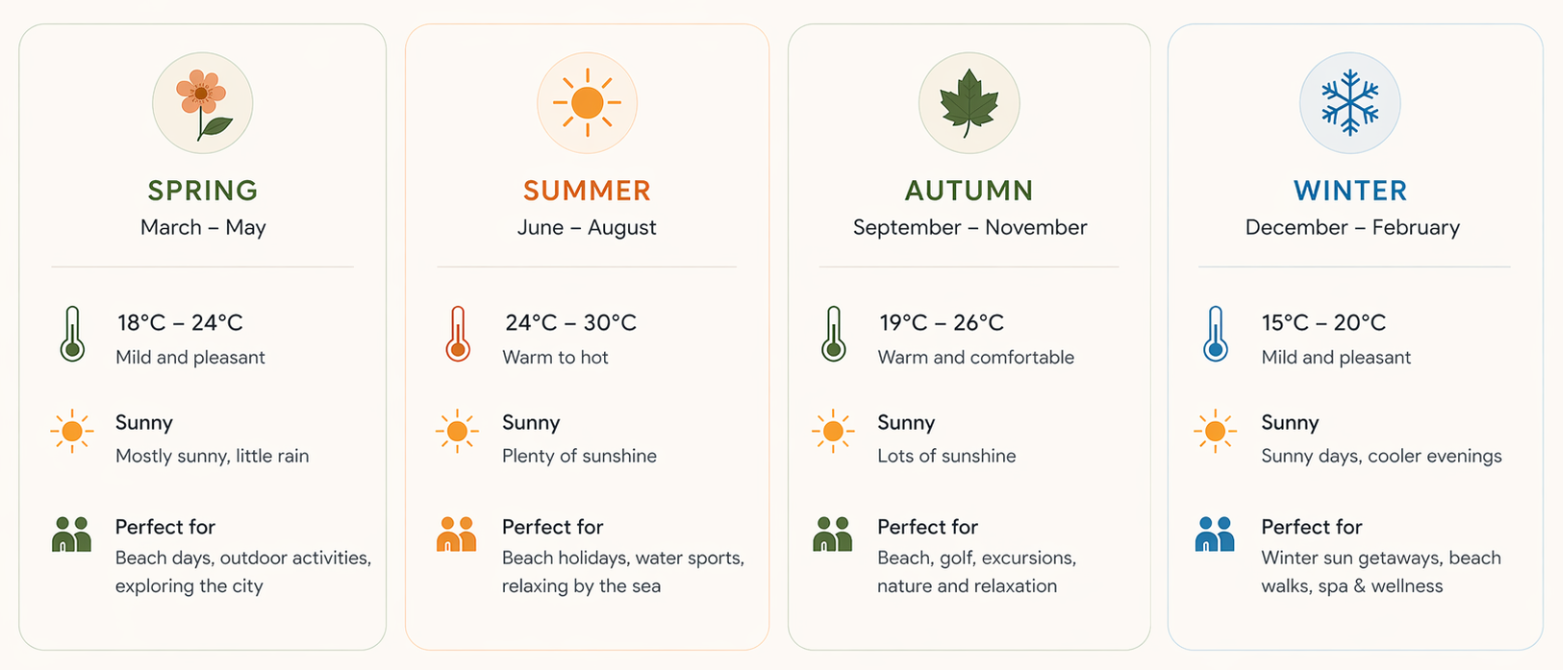
Spring and autumn are the best seasons to visit Agadir. Expect warm, sunny weather, comfortable temperatures, and ideal conditions for beach time, sightseeing, and day trips. Winter is also a great option for a mild sunny escape.
Weather is excellent in winter. Agadir enjoys one of the most reliable climates on Morocco’s coast, with warm, sunny days common even in December and January. Summer can bring Atlantic coastal fog (the “alizé”) in the mornings, and July-August can feel hazy and less reliably sunny than spring or autumn.
First time in Agadir - what you should know
It is a modern, rebuilt city. Agadir was almost entirely destroyed by a devastating earthquake in 1960 and rebuilt from scratch. There is no ancient medina to explore – the old quarter was levelled and never fully restored. What exists today is a planned, relatively functional city with wide boulevards, resort zones, and a seafront promenade.
The beach is genuinely good. The Bay of Agadir stretches for roughly 10 kilometres of sandy beach, well-maintained and lined with cafes, beach clubs, and sun lounger rentals. This is the city’s main draw, and it delivers.
It is more spread out than it looks. The beach area, the marina, the city centre, the souk, and the residential quarters are not all within easy walking distance of each other. Budget for taxis or choose your neighbourhood carefully.
The atmosphere is relaxed by Moroccan standards. Compared to Marrakech, Agadir is noticeably less intense. Street hassle is lower, the city feels more tourism-accustomed, and visitors generally report a calmer experience on the ground.
It is heavily resort-oriented. A large proportion of Agadir’s accommodation is all-inclusive hotels clustered along the bay. This shapes the experience – the city can feel somewhat insulated from everyday Moroccan life, particularly if you stay in a large resort complex.
Top attractions in Agadir
Agadir Beach: The city’s central reason to visit. A wide, well-kept sandy beach running the full length of Agadir Bay. Beach clubs offer sun loungers, umbrellas, and snacks. The water is Atlantic, which means it can be cool even in summer. Swimming conditions vary – the sea is generally calm in summer but can be rough in winter, with strong currents and swell. Pay attention to lifeguard flags.
The Seafront Promenade : Running parallel to the beach, the promenade (Boulevard du 20 Aout) is good for an evening walk, lined with cafes, restaurants, and juice bars. It has a pleasant, easy atmosphere – nothing cutting-edge, but functional and enjoyable.
Agadir Oufella – the Kasbah Viewpoint: The ruins of the old Kasbah sit on the hill above Agadir and offer the best panoramic view over the bay, the city, and the coastline. The ruins themselves are sparse – there is not much left after the 1960 earthquake – but the view at sunset is worth the trip. Access is possible by road or on foot from the old Talborjt neighbourhood.
The Cable Car (Téléphérique): A cable car running between the seafront area and the hilltop near the Kasbah. Useful if you want the view without the climb. Not a must-do, but pleasant and quick.
Souk El Had: Agadir’s main market, and one of the largest weekly souks in Morocco. It covers everything from spices and argan oil to clothing, leather, and produce. Far less touristy in feel than the souks of Marrakech, and worth a morning visit. Bargaining is standard.
The Marina: A pleasant waterfront area south of the main beach, with restaurants, cafes, boutiques, and boat trips available. Good for a relaxed evening out. More upmarket in feel than the main promenade.
Crocoparc: A crocodile park and botanical garden located outside the city centre. Popular with families. Well-maintained with a good variety of Nile crocodiles and tropical gardens. A solid half-day option for those travelling with children.
Taghazout: A former fishing village turned surf destination, about 18 kilometres north of Agadir. The village itself is compact and has grown significantly in recent years, with boutique guesthouses, surf camps, and cafes. The beach breaks here attract surfers from around the world. Worth a day trip even if you do not surf – it has a different energy to Agadir and gives a better sense of the Atlantic coast. See the full Taghazout guide for more detail.
Paradise Valley: An inland canyon and natural swimming hole around 30 kilometres from Agadir, accessible by road into the foothills of the Anti-Atlas. A popular excursion combining a scenic drive with the option to swim in natural rock pools (water levels and conditions vary by season). Best visited with a guide or as part of a day trip.
Where to stay - quick overview
Choosing the right area in Agadir matters more than in a compact city like Marrakech:
Beachfront / Agadir Bay (Boulevard du 20 Aout): The main resort strip. Most of the large all-inclusive hotels are here, and it is the most convenient area for beach access. Best for: families, resort stays, sun-and-sea trips. Downside: can feel enclosed and detached from local life.
Founty / Southern Bay: The southern end of the bay, home to some of Agadir’s larger and newer resort complexes. A quieter end of the beach with good amenities. Best for: those wanting a larger resort with a less busy stretch of sand.
The Marina: A more polished, modern area with higher-end restaurants, some boutique hotels, and a pleasant waterfront atmosphere. Less beach-direct but a good base if you want to eat out and explore more independently. Best for: couples and independent travellers.
Talborjt / City Centre: The traditional Agadir city centre and one of the older residential neighbourhoods. More local in feel, with cheaper accommodation options and closer to Souk El Had. Less beach-convenient. Best for: budget travellers and those wanting a more authentic slice of local life.
Taghazout or Tamraght (alternatives outside the city): If your focus is surfing or a slower, more village-based experience, the small surf towns north of Agadir offer a very different atmosphere. Accommodation ranges from surf hostels to boutique guesthouses. You give up city infrastructure but gain character. Worth considering for surfers and those who find Agadir too resort-heavy.
For more details, check our detailed Agadir Hotel Guide.
Hotels & resorts in Agadir
Best tours from Agadir
Getting there and around
Getting to Agadir
Agadir Airport: Agadir Al Massira Airport (AGA) is the city’s international airport, located around 25 kilometres south-east of the city centre. It receives direct flights from across Europe, including regular connections from the UK, France, Spain, Germany, and the Netherlands. Ryanair, easyJet, and Royal Air Maroc operate routes here.
Airport to City: There is no train or metro link from the airport to the city. Your options are:
- Taxi (Grand Taxi): The standard option. Negotiate or confirm the fare before getting in. Expect to pay in the range of 150-250 MAD for the central area, depending on the time of day and your bargaining. Some hotels offer fixed-rate transfers.
- Pre-booked transfer: Increasingly popular and removes the negotiation step entirely. Several operators and hotels offer this.
- Bus: Local bus connections from the airport exist but are slow and infrequent. Not recommended for arrivals with luggage.
Getting around
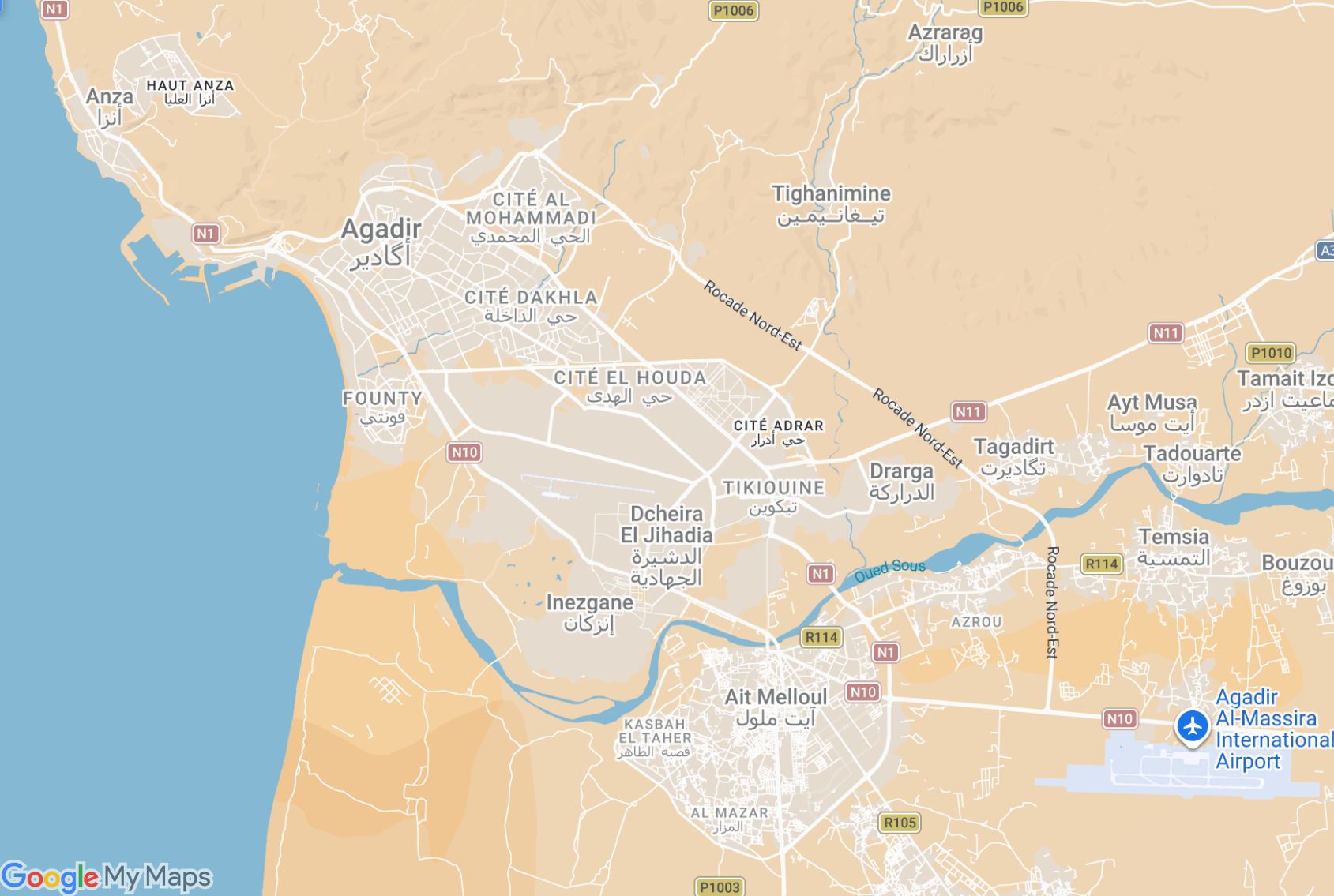
Petit taxis are the main way to move around the city. They are small, metered, and relatively inexpensive – but in practice, drivers will often propose a flat fare rather than using the meter. For short urban trips this is usually fine; for longer journeys, agree the price before departure to avoid disputes.
Grand taxis serve fixed intercity routes to Taghazout, Tamraght, Inezgane, and other nearby towns at shared-ride prices.
Local buses cover main routes including the airport connection and Taghazout. Cheap but can be slow and crowded.
Do you need a car? Within central Agadir, no – the beach strip is walkable or taxi-able and most day trips can be arranged as group excursions. If you plan to explore the coast independently, visit multiple day-trip destinations, or travel south towards Tiznit and Sidi Ifni, a rental car makes a significant difference.
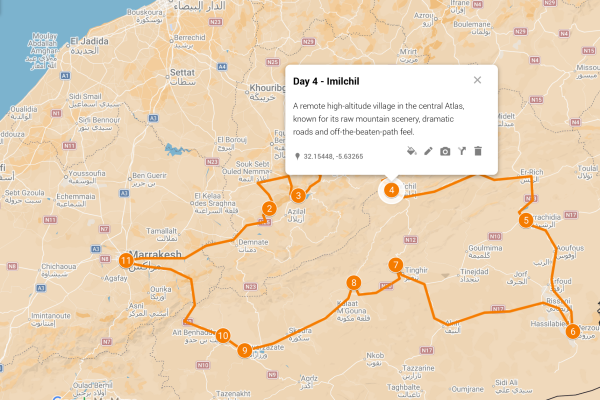
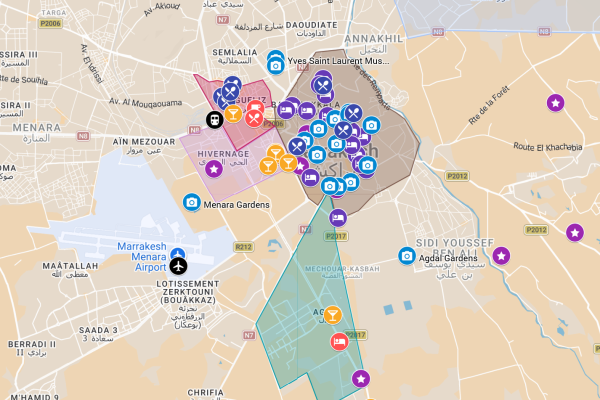
Plan your Morocco Trip with our Free Morocco Travel Maps
Ready-made itineraries for 3, 7, 10 and 14 days
Best spots by city, coast, desert & mountains
Handpicked hotels, riads & resorts
Restaurants, viewpoints & activities
Key neighborhoods & transport tips
Free access. Regular updates. No spam.
Safety and practical reality
General safety: Agadir is one of the more straightforward cities in Morocco for first-time visitors. Petty crime exists but serious incidents targeting tourists are rare. Normal urban precautions apply.
Taxi overcharging: This is the most common friction point for visitors. Drivers occasionally charge inflated rates, particularly at the airport and to and from the beach strip at night. Always agree the price before getting in, or insist on the meter in petit taxis.
Beach and swimming: The Atlantic here is not the Mediterranean. Water temperatures are cooler than many visitors expect, even in summer. More importantly, swell and currents can be strong, particularly in winter months (November to March). Lifeguard flags on Agadir beach are taken seriously – when red flags are displayed, the sea is genuinely not safe to swim in. Pay attention to these signals.
Water quality near Taghazout: Local concern about wastewater discharge near Taghazout has been raised periodically. If swimming is a priority there, check local conditions beforehand.
Summer fog: July and August can bring Atlantic coastal fog (known locally as the alizé), particularly in the mornings. It usually clears by midday, but it can make early mornings grey and overcast. Spring and autumn tend to offer cleaner, clearer skies.
Atmosphere and authenticity: Agadir is a pragmatic city, not a deeply atmospheric one. Visitors who arrive expecting a traditional Moroccan experience often feel the city lacks texture. Setting realistic expectations before arrival makes a significant difference to how the trip is experienced.
Unmarried couples: Non-Moroccan, non-Muslim couples sharing rooms encounter very few practical issues at the international hotels and resort properties that make up the bulk of Agadir’s accommodation. It is worth checking specific property policies if you are booking a smaller, locally-run guesthouse.
Frequently Asked Questions about Agadir
Is Agadir worth visiting?
Yes – on the right terms. If you want a reliable, beach-focused Morocco holiday with good weather, easy logistics, and a relaxed pace, Agadir delivers. If you are hoping for a deeply traditional or atmospheric Moroccan experience, it will likely disappoint. Knowing which you are after before you book is the key.
Is Agadir better than Marrakech?
They serve different purposes. Marrakech is one of Africa’s great historic cities – intense, atmospheric, and rich in culture and heritage. Agadir is a beach resort. Choose Marrakech for culture and immersion; choose Agadir for sun, sea, and an easy holiday.
How many days do you need in Agadir?
3-4 days is the sweet spot for most visitors. This covers the beach, the main sights, and a day trip or two. For a pure beach holiday with a slower pace, 5-7 days works well.
Is Agadir good for families?
Yes, it is one of the better family beach destinations in Morocco. The beach is safe in good conditions, the resort infrastructure is well-developed for families, the city is easy to navigate, and activities like Crocoparc are genuinely well-suited to children.
Is Agadir good in winter?
Yes. Agadir’s winter sun reputation is well-founded. December, January, and February often bring warm, bright days – a major draw for Europeans escaping cold winters. The sea may be too rough for swimming in some periods, but the weather for walking, sightseeing, and day trips is often excellent.
Is Agadir good in summer?
Summers are warm and the beach is busy, but July and August can also bring morning coastal fog and haze from the Atlantic. Temperatures rarely become oppressively hot (unlike inland Morocco), but the weather is less reliably brilliant than in spring or autumn. May-June and September-October tend to offer the best combination of warmth, sunshine, and crowd levels.
Is Agadir or Taghazout better?
They suit different travellers. Agadir has better infrastructure, more accommodation options, more restaurants and services, and easier logistics. Taghazout is smaller, more characterful, surf-focused, and has a younger, more independent atmosphere. Agadir is better for families and first-timers; Taghazout is better for surfers and those wanting something with more personality. It is also easy to do both – Taghazout makes a very natural day trip from Agadir.
Do you need a car in Agadir?
Not for the city itself. Taxis cover the beach strip, the marina, the souk, and the Kasbah efficiently enough. For independent day trips to Paradise Valley, Taroudant, Souss-Massa, or the coast south of Agadir, a rental car significantly opens things up. Group excursions are widely available as an alternative if you prefer not to self-drive.
Links & ressources
Learn more about the History of Agadir
National train company website
National shuttle company website
Official Agadir Airport Website
Page last updated: June 2026
Anything we can improve? Let us know
Plan Your Morocco Trip
Compare hotels, flights and rental cars
Compare hotels, riads and guesthouses across Morocco on Booking.com:
Compare flights to Morocco on Aviasales:
Find the right rental car for your Morocco trip with EconomyBookings: