Stories >
Moroccan Interior Design: The Quiet Logic Behind Moroccan Homes
How light, texture, zellige, tadelakt and craft shape the warmth, privacy and beauty of Moroccan interiors.
May 5, 2026
Moroccan interior design is often reduced to its most recognizable objects: brass lanterns, leather poufs, carved cedar doors, colorful tiles and handwoven rugs. These pieces are beautiful, and they matter. But they are not the whole story.
The deeper beauty of Moroccan interiors is not in the objects themselves. It is in the atmosphere they create.
A good Moroccan interior knows how to soften light, hold shade, cool the air, frame silence, welcome guests and make a room feel layered without becoming chaotic. It is not decoration for decoration’s sake. It is a way of thinking about space, comfort and daily life.
That is why the best Moroccan interiors rarely feel staged. They feel sheltered, human and quietly alive.

Moroccan Design Begins With Climate, Not Decoration
Before Moroccan design became a mood board, it was shaped by a country of strong contrasts: hot afternoons, cool nights, dry summers, mountain winters, coastal light and desert air.
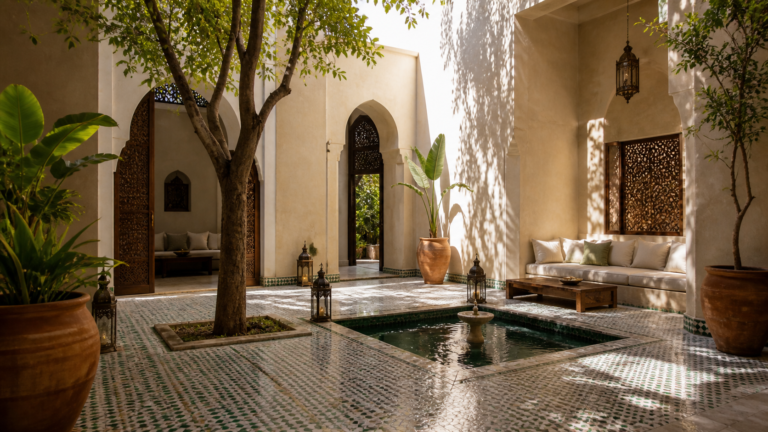
Many of the features people now admire in Moroccan interiors began as practical responses to climate. Thick walls help keep rooms cool. Courtyards bring air and light into the heart of a home. Fountains add sound, movement and a feeling of freshness. Tiled floors, plaster walls and shaded patios all help create interiors that feel calm even when the outside world is harsh or busy.
This is one of the reasons Moroccan design has such depth. It is not just decorative. It has logic.
Zellige, tadelakt, carved screens, courtyards and shaded terraces are beautiful because they work. They control light, temperature, privacy and movement. Their beauty comes from use, not from styling alone.
The Beauty of the Inward-Facing Home
One of the most distinctive ideas in Moroccan architecture is the inward-facing home.
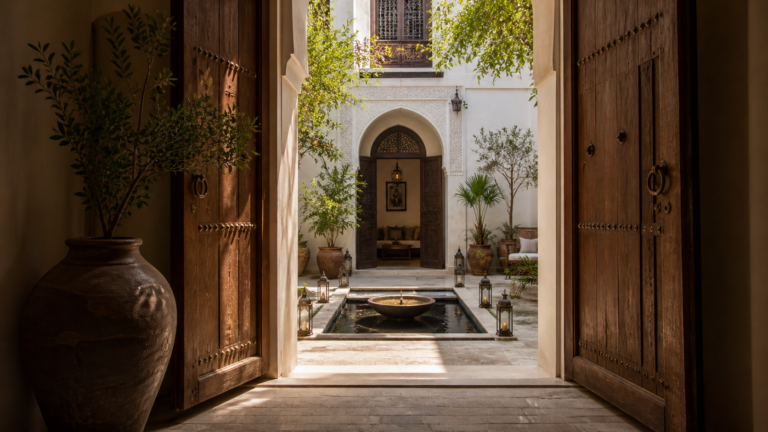
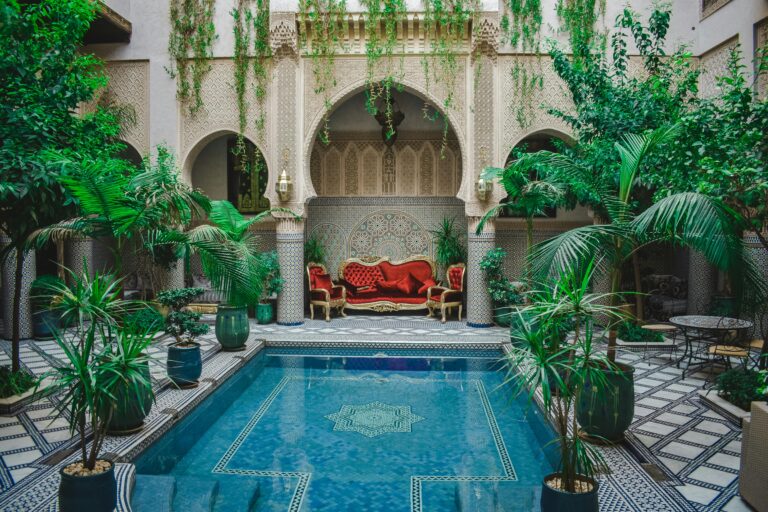
From the street, a traditional Moroccan house can look almost silent. The façade may be plain, the windows discreet, the door heavy and closed. But once inside, the space opens into another world: a courtyard, a garden, a fountain, rooms facing inward, light falling from above.
This is the logic of the riad.
The house does not try to impress the street. It saves its beauty for the people inside. That sense of privacy is central to Moroccan interiors. Luxury is not always displayed. Often, it is revealed slowly.
A riad interior understands something that many modern homes forget: the most memorable spaces are not always the loudest. Sometimes, the real pleasure is in the transition from noise to calm, from public to private, from heat to shade.
Light Is the Main Material
In many interiors, light is treated as something added at the end. In Moroccan design, it is part of the architecture from the beginning.
The central courtyard of a riad acts like a light well. It brings daylight into the home without exposing it fully to the street. As the sun moves, the mood of the space changes. Morning light, afternoon shade and evening glow each give the same room a different feeling.
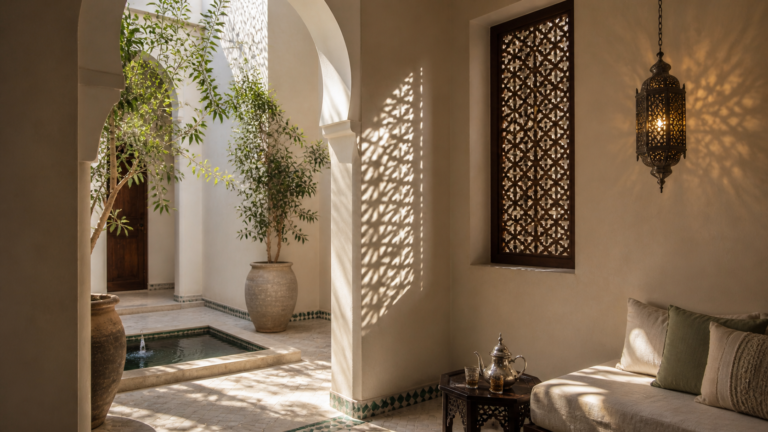
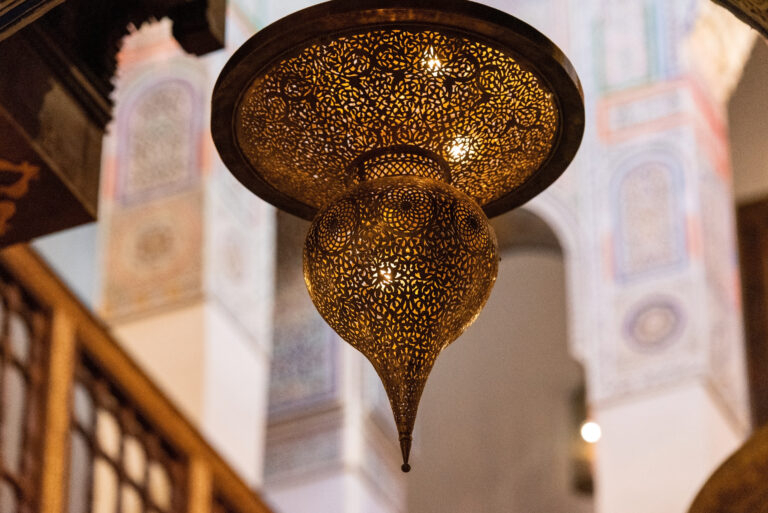
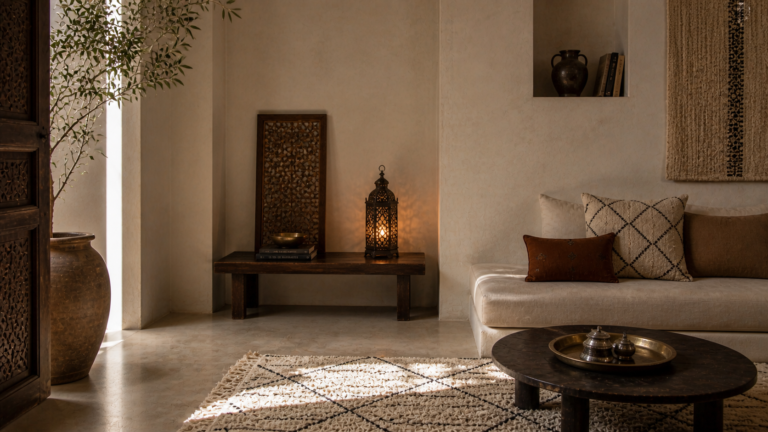
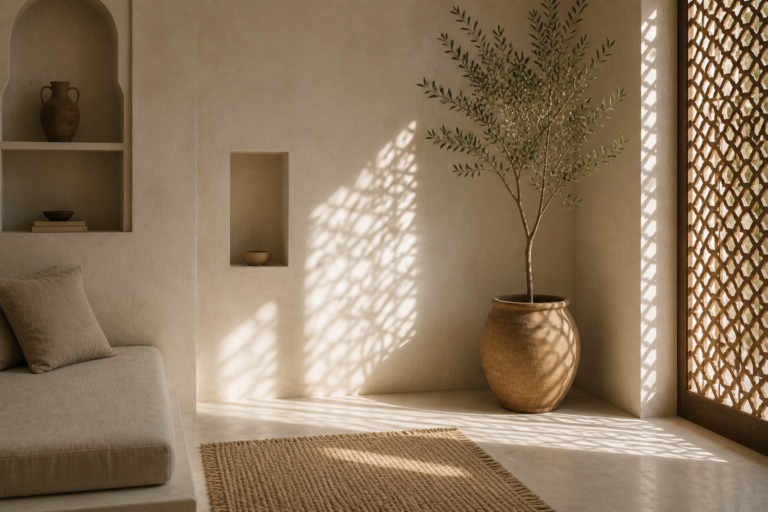
Moucharabieh screens, carved plaster, wooden latticework and Moroccan lanterns all work with the same idea: light should be filtered, softened and shaped.
A Moroccan lantern is not just a pretty object. Its real power is in the shadows it casts. Pierced metal and colored glass can turn a plain wall into something alive, especially at night. The effect is not about brightness. It is about warmth, intimacy and movement.
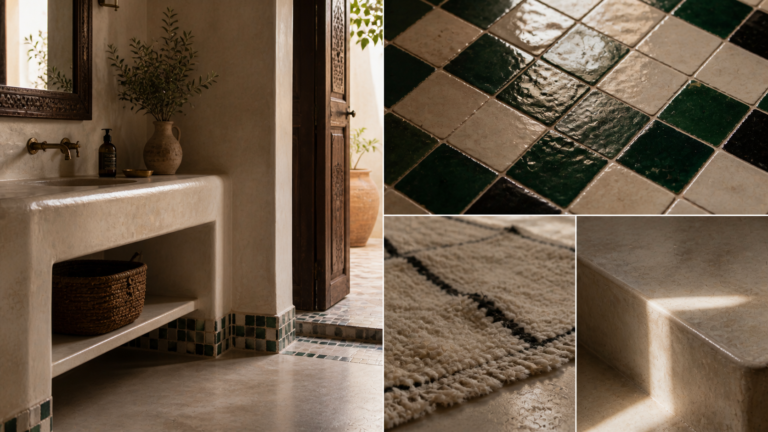
Zellige works in a similar way. Because each tile is slightly irregular, the surface catches light unevenly. A wall of zellige can shimmer without needing to shout.
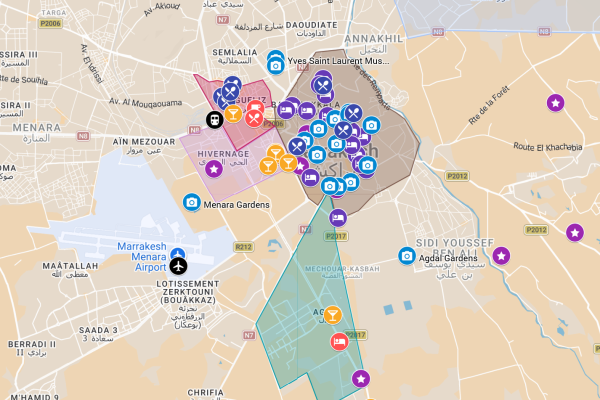
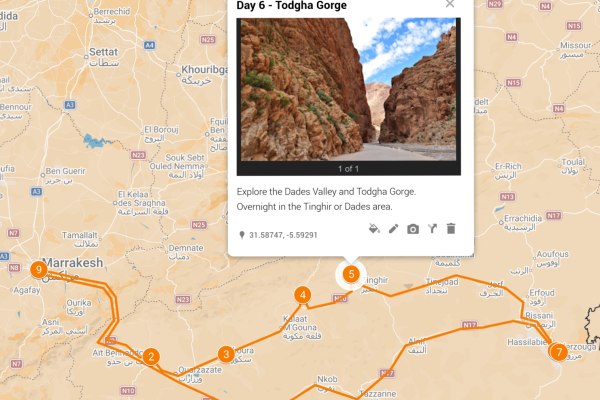
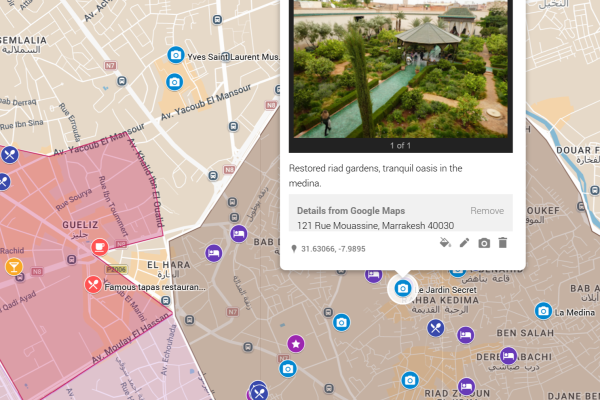
Plan your Morocco Trip with our Free Morocco Travel Maps
Ready-made itineraries for 3, 7, 10 and 14 days
Best spots by city, coast, desert & mountains
Handpicked hotels, riads & resorts
Restaurants, viewpoints & activities
Key neighborhoods & transport tips
Free access. Regular updates. No spam.


Calm Surfaces Make Decorative Details Stronger
Moroccan interiors are often described as maximalist. Some are. But the most beautiful ones usually understand restraint.
A carved cedar door looks stronger against a plain wall. A Beni Ourain rug feels more elegant when the room around it is calm. A panel of zellige becomes more powerful when it is not fighting with ten other patterns. A brass lantern glows better in a space that gives it room.
This is where many people get Moroccan style wrong. They try to combine every recognizable Moroccan element at once: rugs, poufs, lanterns, tiles, mirrors, carved screens, bright colors and patterned cushions. The result often feels more like a themed restaurant than a real home.
The best Moroccan interiors are more intelligent than that. They balance detail with silence. They let handmade objects breathe.
A room does not need to scream Morocco to feel Moroccan.
Imperfection Is Part of the Luxury
One of the great lessons of Moroccan interior design is that imperfection can feel more luxurious than perfection.
Hand-cut zellige does not sit with machine-made precision. That is the point. Each tile reflects light differently. The surface has movement, depth and life.
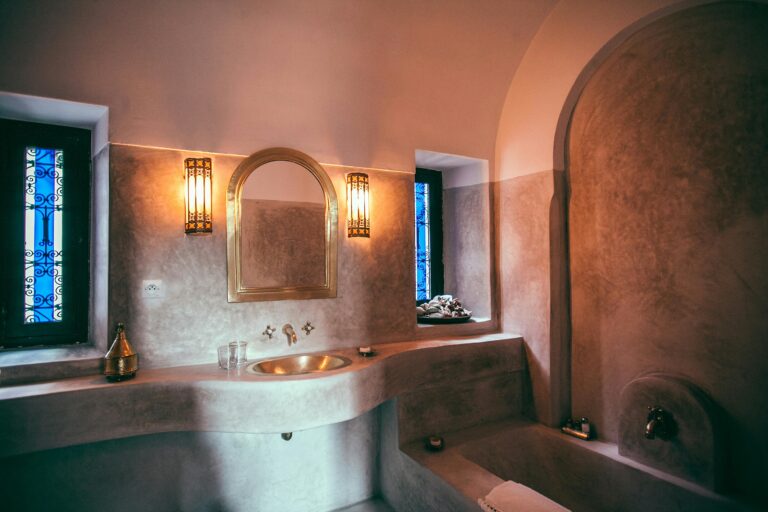
Tadelakt, the traditional polished lime plaster used in Moroccan bathrooms, hammams and riads, has a softness that paint cannot imitate. It is smooth but not flat, refined but not sterile.
Moroccan rugs carry the hand of the person who made them. A Beni Ourain rug may look simple from a distance, but up close, the wool, knots and small irregularities give it character. Azilal rugs, kilims and other Moroccan rugs often have the same quality: they feel alive because they are not perfectly industrial.
This is not rustic for the sake of being rustic. It is craft as quiet luxury.
In a world full of identical finishes and showroom interiors, Moroccan materials remind you that a beautiful space does not need to be flawless. It needs texture, age, touch and presence.
Moroccan Interiors Are Social Spaces
Moroccan interiors are also shaped by hospitality.
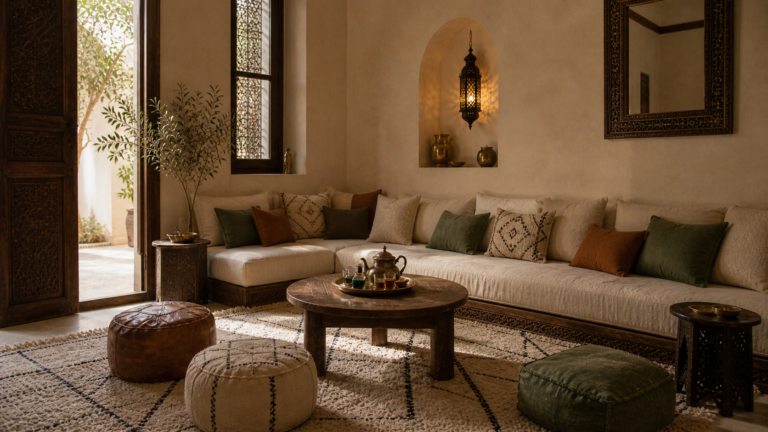
The Moroccan salon is not designed around one dominant object. It is designed around gathering. Seating is low, generous and often arranged along the walls, creating space for family, guests, conversation and tea.
This changes the feeling of a room. People are not positioned like an audience. They are brought into a shared space.
Low tables, trays, rugs, cushions and poufs all make sense in this context. They are not just decorative accessories. They support a way of living where people sit, talk, eat, drink tea and stay longer than planned.
That is why Moroccan interiors can feel so warm. They are not only designed to be looked at. They are designed to receive.
How to Translate Moroccan Design Without Creating a Theme Room
The best way to bring Moroccan style into a home is not to copy a riad piece by piece. It is to understand the principles behind it.
Start with atmosphere rather than objects.
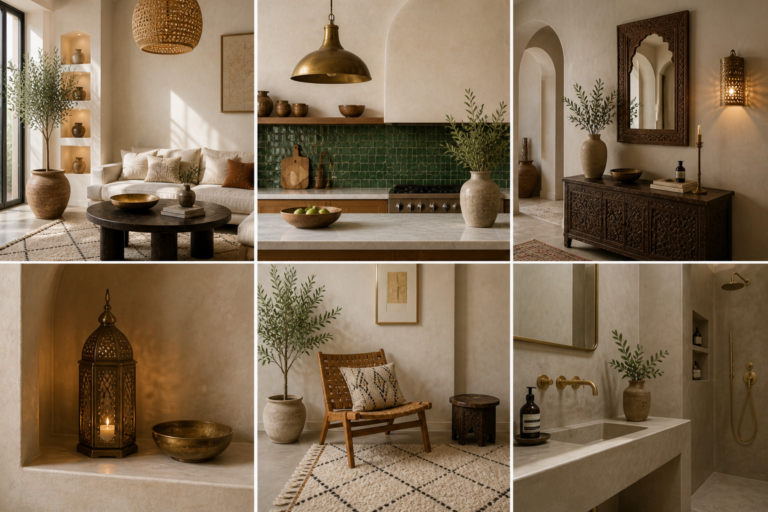
Think about warm light, natural texture, soft walls, generous seating, shade, handcrafted details and one or two strong focal points. That could be a large Moroccan rug, a zellige backsplash, a brass pendant, a carved wooden mirror or a limewash wall that gives the room depth.
The key is to choose carefully.
If the rug is expressive, keep the walls calmer. If the zellige is strong, let the surrounding surfaces stay simple. If the lantern is ornate, avoid filling the room with competing metalwork. Moroccan interiors work best when contrast is controlled.
The goal is not to turn a London apartment, a Paris flat or a modern villa into a fake riad. The goal is to borrow the logic: warmth, shade, texture, craft and hospitality.
That is much more elegant than copying the look.
Living Room
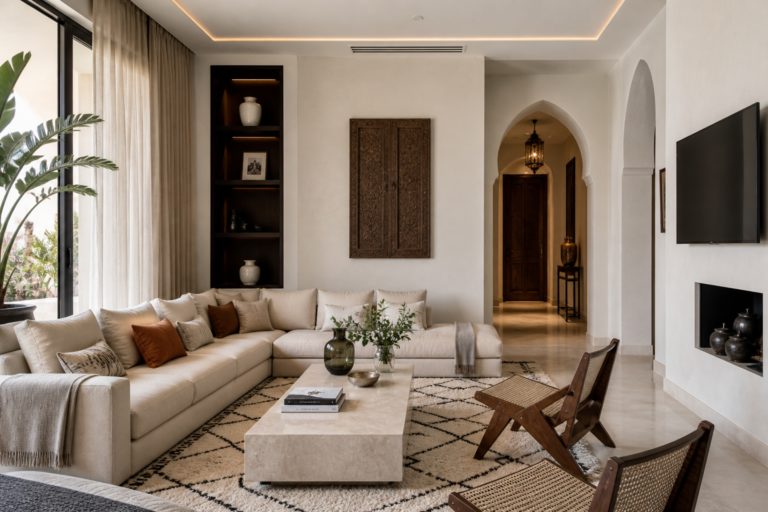
A Moroccan-inspired living room should begin with comfort and atmosphere.
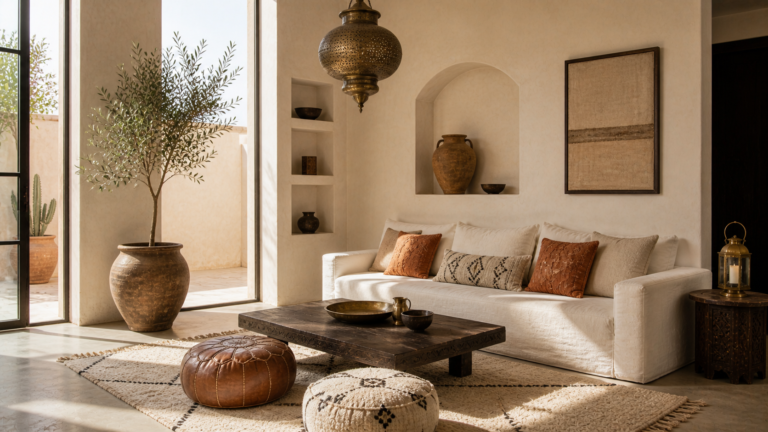
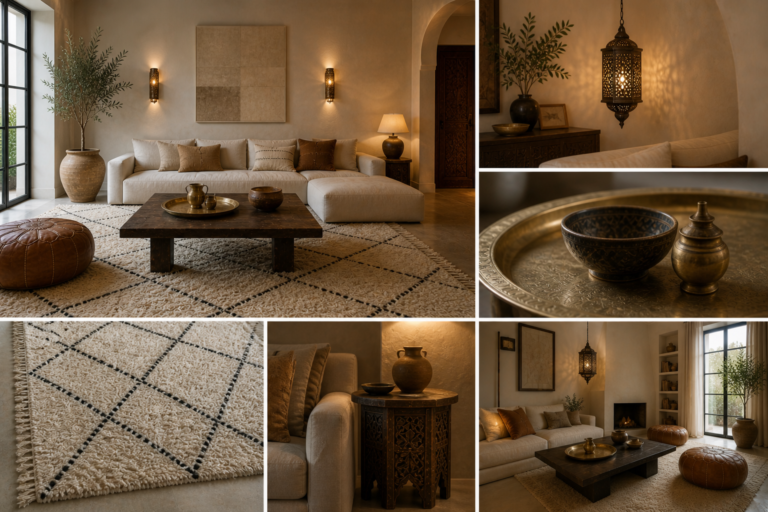
A generous rug can anchor the room, especially if it has real texture. A Beni Ourain rug brings softness and calm, while a more colorful Moroccan rug can become the main visual element. Around it, the rest of the space should support the mood rather than compete with it.
Lighting matters more than most people think. Warm lamps, wall sconces or a single Moroccan lantern can create a better effect than a bright overhead light. Add one handcrafted piece, perhaps a brass tray, a ceramic bowl or a carved side table, and stop before the room becomes too busy.
The most elegant Moroccan style often comes from knowing when to stop.
Bedroom
A bedroom should be calmer.
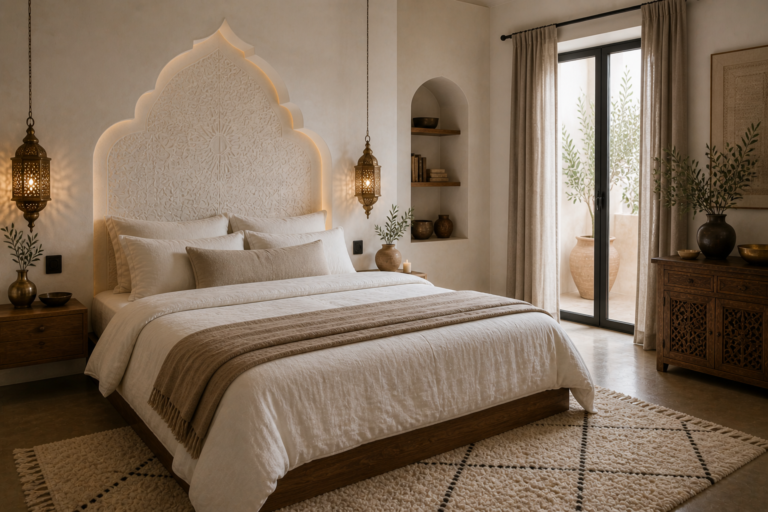
This is where Moroccan interiors can become almost minimalist, if handled well. Warm white walls, soft plaster, linen bedding, dark wood and a simple rug can create a room that feels peaceful without being empty.
A Beni Ourain rug beside the bed works especially well because it adds softness without overwhelming the space. A small brass lamp, a carved wooden detail or a piece of handmade ceramic can be enough.
The bedroom should not feel like a souvenir shop. It should feel like rest made visible.
Bathroom
The bathroom is one of the most natural places to use Moroccan materials.
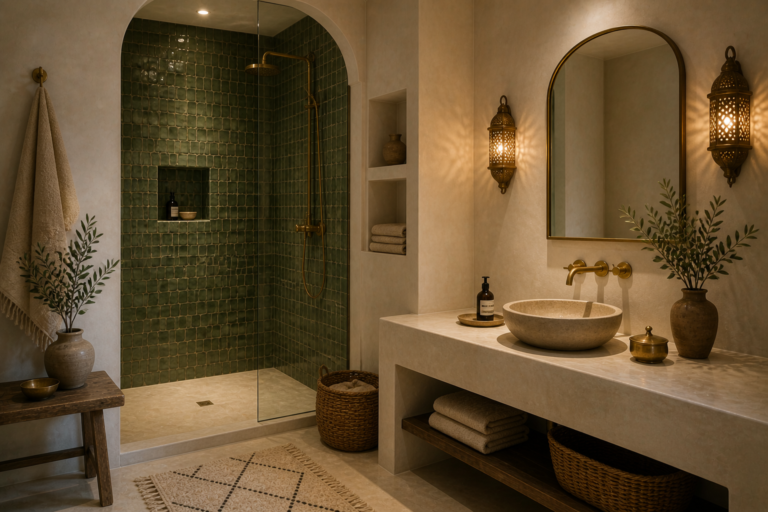
Zellige works beautifully around a shower, basin or backsplash because water brings out the depth of the glaze. Tadelakt is even more closely tied to Moroccan bathing culture, especially hammams, where smooth plaster, warmth and steam create a deeply sensory space.
The trick is not to overdo it. One zellige wall can feel refined. An entire bathroom covered in pattern may feel heavy.
Pair handmade surfaces with simple fixtures, soft towels and warm lighting. The result should feel quiet, mineral and tactile.
Terrace or Patio
Moroccan design feels especially natural outdoors.
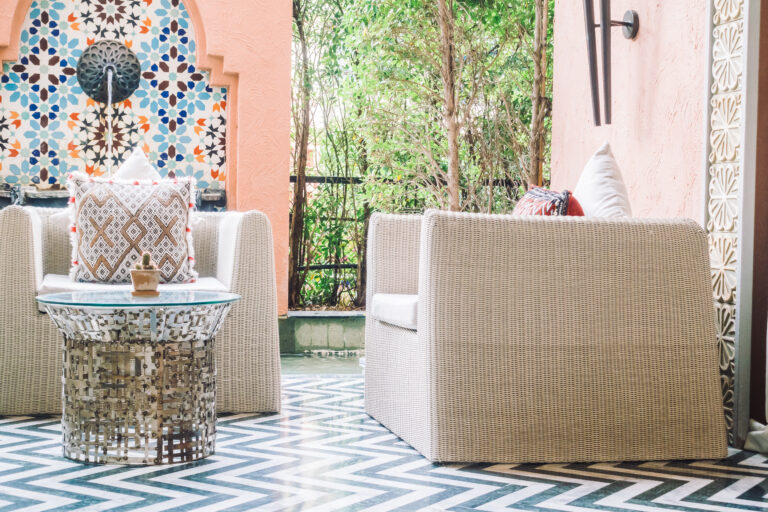
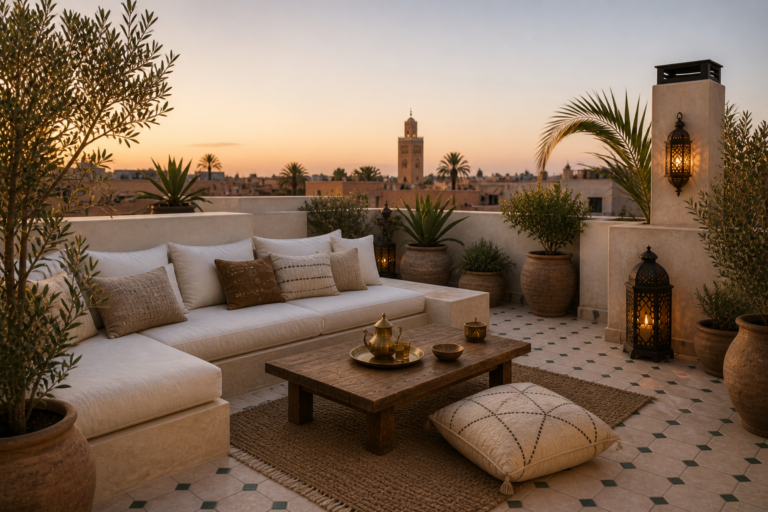
A terrace, balcony or patio can borrow from Moroccan interiors without needing much decoration. Low seating, clay pots, woven textures, a tiled floor, plants, shade and a lantern or two can be enough.
The Moroccan approach to outdoor space is not just about sunshine. It is about creating a place to sit comfortably at the edge of the day, when the light softens and the air cools.
That feeling matters more than any single object.
The Real Lesson of Moroccan Design
Moroccan interior design is not a decorative costume. It is a way of thinking about what a space should do.
It should shelter. It should soften light. It should make room for texture and silence. It should welcome people without trying too hard. It should allow beauty to appear gradually, through materials, shadows, details and use.
Moucharabieh screens, carved plaster, wooden latticework and Moroccan lanterns all work with the same idea: light should be filtered, softened and shaped.
The objects matter, but they are not the starting point. The real lesson is quieter: warmth comes from light, beauty comes from restraint, and a home feels most alive when it leaves room for people to gather, rest and stay a little longer.
Page last updated: June 2026
Anything we can improve? Let us know
Plan Your Morocco Trip
Compare hotels, flights and rental cars
Compare hotels, riads and guesthouses across Morocco on Booking.com:
Compare flights to Morocco on Aviasales:
Find the right rental car for your Morocco trip with EconomyBookings: